Skip to content
Introduction: The High Stakes of Global Procurement

For procurement officers, real estate developers, and structural engineers managing large-scale construction projects, the building envelope represents the most critical line of defense against environmental degradation. Specifying inferior sheathing materials inevitably leads to severe architectural pain points, including chronic water rot, toxic mold proliferation, and catastrophic structural failure during fire events. Consequently, global buyers understand that the single most decisive factor in supply chain stability and project longevity is partnering with a reliable cement board manufacturer. This decision is particularly complex when navigating the vast industrial landscape of China, the world’s leading producer of construction panels.
The market is saturated with countless suppliers, ranging from technologically advanced, compliant factories to under-equipped trading companies posing as manufacturers. Importing from an unverified source introduces unacceptable levels of risk, including non-compliance with local building codes, erratic quality control between batches, and logistical delays that destroy project timelines.
For B2B buyers seeking to import high-performance documents sheathing that successfully balances cost-efficiency with uncompromising engineering standards, establishing a rigorous vetting protocol is mandatory. This comprehensive guide dissects the technical markers of a top-tier producer and outlines how to establish a secure, factory-direct partnership in China.
Core Physics & Material Advantages

A B2B buyer’s first step in vetting a reliable cement board manufacturer is auditing their raw material composition and manufacturing physics. A leading China building materials supplier, such as TSMBoard.com, distinguishes itself through a precise, inorganic crystalline matrix formulation. Engineers must demand transparency regarding the Portland cement grade, silica sand purity, and the specific reinforcement reinforcing mesh utilized in the extrusion process. Top-tier factories utilize high-compressed technology to cure the boards, creating a substrate with profound dimensional stability.
Furthermore, a critical marker of a premium product is the absence of hazardous additives. Importers must verify that the supplier guarantees a 100% asbestos-free composition. Inorganic Portland cement panels naturally resist dynamic environmental stressors. Unlike organic-based sheathing, these factory direct construction panels do not serve as a food source for mold or termites, even when subjected to subterranean hydrostatic negative-side pressure. The material’s immunity to water rot guarantees that it maintains its flexural strength throughout the structure’s lifespan.
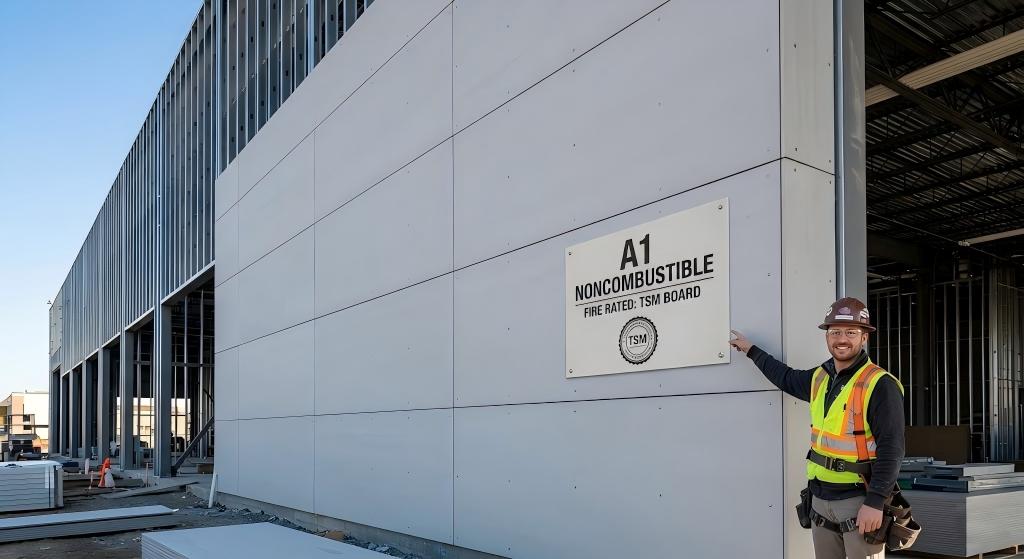
Moreover, the material physics provide substantial passive fire protection. A reliable cement board manufacturer produces panels that achieve Class A1 non-combustible ratings according to strict EN and ASTM standards. The intense density of high-quality cement boards also provides superior Sound Transmission Class (STC) ratings. Consequently, this density makes them an ideal acoustic wall panels substrate for demising walls in multi-family residential projects. Engineers specify these heavy-duty constructions boards not merely as sheathing, but as integral components of high-performance architectural envelopes.
Critical Applications & Real-World Use Cases
Understanding how factory direct construction panels perform under extreme, real-world conditions on construction sites is essential for any importer vetting a China building materials supplier. A versatile, high-compressed cement board supports an extensive range of critical applications across residential, commercial, and industrial sectors.
Exterior Facades and Rainscreen Systems
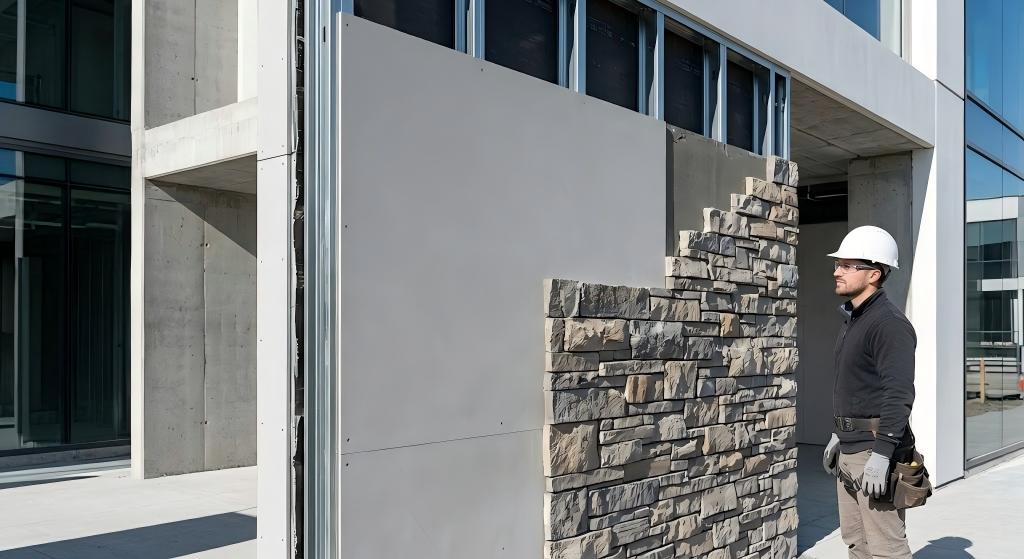
The most severe test of any sheathing material is continuous exposure to exterior elements. Contractors require moisture-resistant tile substrates for exterior insulation and finish systems (EIFS) and ventilated rainscreens. Furthermore, a CE certified cement boards producer ensures the panel survives dynamic wind loads and freeze-thaw cycles without delaminating. Consequently, many architects specify these robust construction panels as the primary substrate for stone veneer cladding on high-rise buildings, where sheathing flexure is not permitted. Therefore, contracting with a reliable manufacturer guarantees the exterior envelope remains unyielding against relentless hydrostatic vapor drive.
Bathrooms, Spas, and Specialty Pool Environments
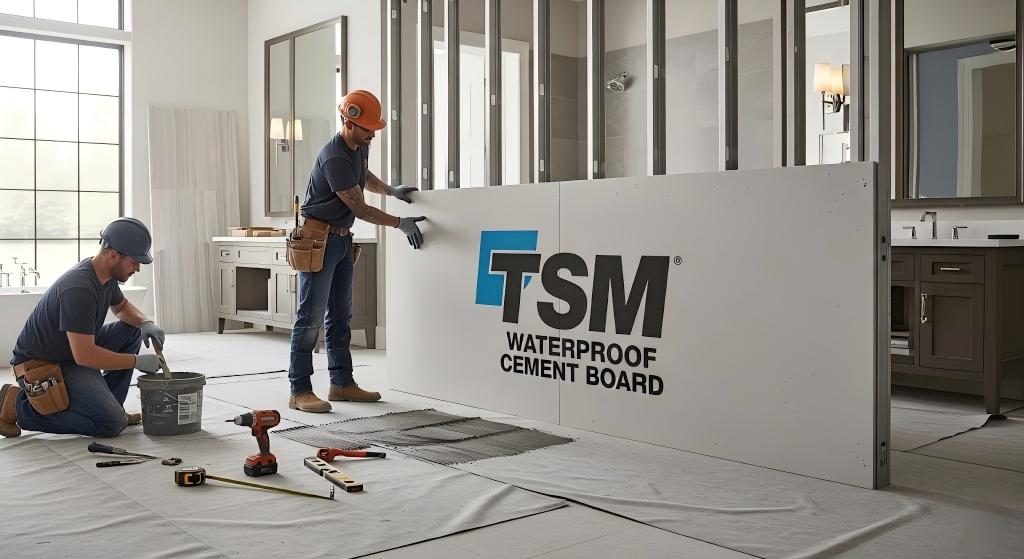
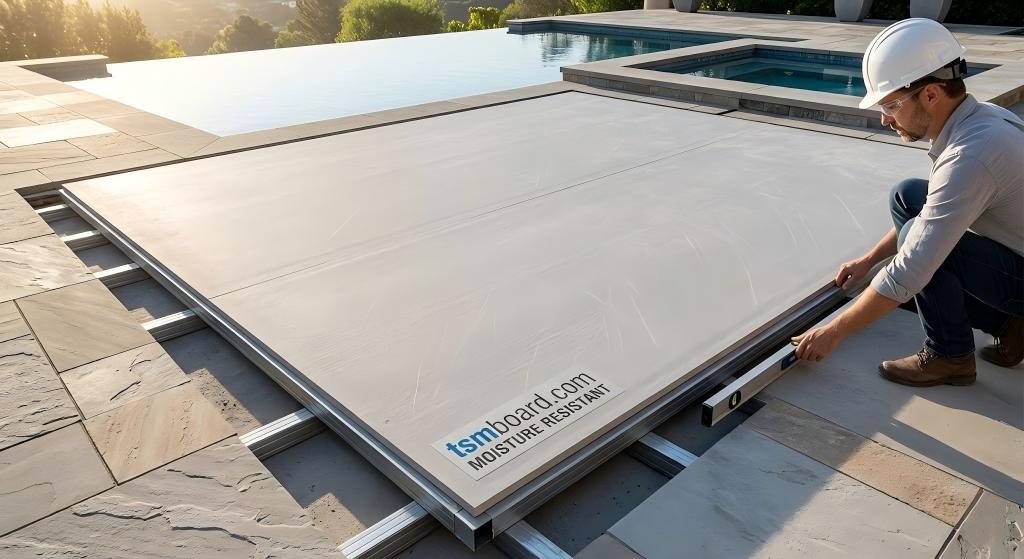
Interior applications in wet areas demand absolute immunity to moisture rot. Importers supply high-end luxury resorts and multi-family developments where standard drywall is negligent engineering. Therefore, these specialized moisture resistant tile substrates form the necessary rigid, non-rotting backbone for heavy porcelain tiles in walk-in showers and steam rooms. Furthermore, contractors utilize these boards for critical applications in outdoor BBQ construction and indoor Jacuzzi surrounds, where intense heat and humidity simultaneously attack the building structure.
Fire-Rated Demising Walls and Subterranean Use
In multi-story commercial high-rises, fire compartmentalization is a strict legal requirement. A reliable cement board manufacturer provides panels integrated into tested passive fire protection assemblies for elevator shafts and stairwells. Moreover, the product’s total immunity to mold proliferation makes it the definitive sheathing for subterranean wall materials and basement finishing. Consequently, these inorganic panels permanently secure the building against fungal germination and termite infestation below grade. Therefore, developers guarantee long-term indoor air quality (IAQ) and life safety by sourcing directly from compliant China manufacturers.
Comparison Table: TSM Cement Board vs. Standard Substrates
A sophisticated importer understands that product quality in China varies widely. The following table provides a technical comparison, contrasting factory-direct, high-compressed TSM Cement Board against inferior construction sheathing commonly available in the wholesale market.
| Performance Metric | TSM Cement Board (Factory Direct) | Traditional Gypsum Drywall | Standard Plywood Sheathing | Inferior MDF Sheathing |
| Material Composition | High-grade Portland Cement matrix | Calcined Gypsum core w/ paper face | Layers of organic wood veneer | Pulverized organic wood fiber |
| Moisture / Rot Resilience | Exceptional (Inorganic, zero swell). | Terrible (Core disintegrates wet). | Poor (Wicks water, delaminates). | Worst (Irreversible swelling). |
| Fire Resistance Rating | Class A1 (Non-Combustible). | Low (Paper face burns). | Highly Combustible (D/E class). | Combustible (Active fuel source). |
| Biological Resilience (Mold) | Immune (No cellulose, high pH). | Terrible (Paper provides food). | Terrible (Cellulose feeds mold). | Terrible (Binders support mold). |
| Load Capacity (Shear) | Extremely High (Supports heavy stone). | Very Low (Core fractures easily). | High (When dry), deflects loads. | Terrible (Zero shear modulus). |
A B2B buyer utilizes this data during the manufacturer auditing process to verify that the prospective China building materials supplier can mathematically validate their product’s superior specifications against industry standard materials.
Installation Best Practices & Engineering Specs
The quality of the final construction relies on adherence to strict installation protocols. Partnering with a leading reliable cement board manufacturer is mandatory because they provide comprehensive, factory-verified engineering support and technical datasheets (TDS) specifically tailored for international export projects. Importers must review these specifications to ensure the manufacturer understands the standards of the destination country.
Structural Framing and Tolerances
High-density cement boards must be mounted to a rigid frame. Structural engineers mandate galvanized steel studs (minimum 20-gauge, light-gauge steel) rather than wood framing, as wood naturally expands and warps, which transfers kinetic stress to the rigid cement panel. Framing must not exceed 16 inches (406mm) on center (O.C.) to maintain L/360 deflection standards, especially when the board is used as a load-bearing substrate for stone veneer or heavy natural cladding.
Precision Fastening protocols
Installers must never use standard drywall screws to secure high-compressed cement panels. Importers are often responsible for sourcing appropriate hardware alongside the boards. Contractors strictly utilize specialized, alkali-resistant, ceramic-coated screws w/ cutting nibs under the head. Fasteners are driven completely flush w/ the board surface but must not fracture the Portland cement matrix. Leading manufacturers, like TSM Cement Board, specify distinct fastening patterns (perimeter vs. field spacing) and proper edge clearances (typically minimum 1/2-inch or 13mm) to maintain structural continuity.
Joint Treatment and Surface Preparation
To create a monolithic, watertight, and fire-resistant barrier, joint treatment is non-negotiable. Leading factories provide specific guidance: installers must utilize a factory-verified, polymer-modified thin-set mortar and embed alkali-resistant fiberglass mesh tape at all board seams. For subterranean and wet-area construction, contractors mandate applying a secondary liquid-applied waterproofing membrane entirely over the finished documents assembly before final cladding. If the importer ensures the manufacturer provides this technical support, they significantly reduce on-site liability for the contracting company.
FAQ: Sourcing Technical Cement Boards from China
1. How do you verify the manufacturing dimensional tolerances in a wholesale order?
A reliable cement board manufacturer strictly complies w/ ISO 9001 quality management systems. Procurement officers must request recent factory internal audit reports and independent lab verification for batch consistency. Technical tolerances must be explicitly stated in the contract: generally, thickness tolerance is +/- 0.5mm, and diagonal squareness tolerance is +/- 3mm.
2. What type of technical tooling is required for site installation and cutting?
Because high-quality cement boards are engineered w/ Portland cement and silica sand, they are exceptionally dense. Contractors use score-and-snap methods for minimal dust, but dynamic cutting around plumbing fixtures requires a continuous-rim diamond blade. Site safety protocols mandate the use of HEPA-filtered dust extraction and N95 respirators to prevent silica dust inhalation.
3. Does the China supplier provide CE certified cement boards for European projects?
Yes. To verify compliance w/ EU building codes, the importer must demand a valid, factory-direct CE certificate showing testing according to EN 12467:2012+A2:2018. Pure trading companies often present forged or generic certificates. A reliable cement board manufacturer will have their CE certification verified against their factory name on the officially recognized EU notification body database.
4. What are the minimal order quantities (MOQ) and customization capabilities (OEM/ODM)?
For factory-direct pricing, MOQs are typically full container loads (20ft FCL) to optimize shipping costs. A versatile manufacturer in China provides expansive customization options (OEM/ODM). Importers request custom thicknesses (6mm to 30mm), non-standard sheet dimensions (minimizing on-site cutting waste), and private labeling options tailored specifically for their local retail market.
5. What export packing protocols are used to prevent transit damage in high-compressed panels?
High-density construction boards are heavy and brittle if handled improperly during loading. A reliable cement board manufacturer utilizes high-compressed export protocols: sheets are stacked on heat-treated, fumigated ISPM 15 compliant wooden pallets w/ corner protection and strapped securely w/ industrial-grade polyester strapping. Furthermore, the pallets receive a full shrink-wrap cover w/ a moisture-resistant barrier for features stabilization against severe humidity shifts in ocean containers.
6. Can the supplier provide comprehensive fire test data (A1 non-combustible)?
Absolutely. Buyers must verify the Class A1 non-combustible fire rating (EN 13501-1) or ASTM E136 compliance w/ full furnace testing reports. Leading China manufacturers provide specific wall assembly test data demonstrating that their non-rotting, highly versatile panels provide catastrophic fire suppression and do not contribute toxic smoke during thermal events, protecting the structural core of commercial demising walls.
Conclusion: Securing Factory-Direct Supplies from China
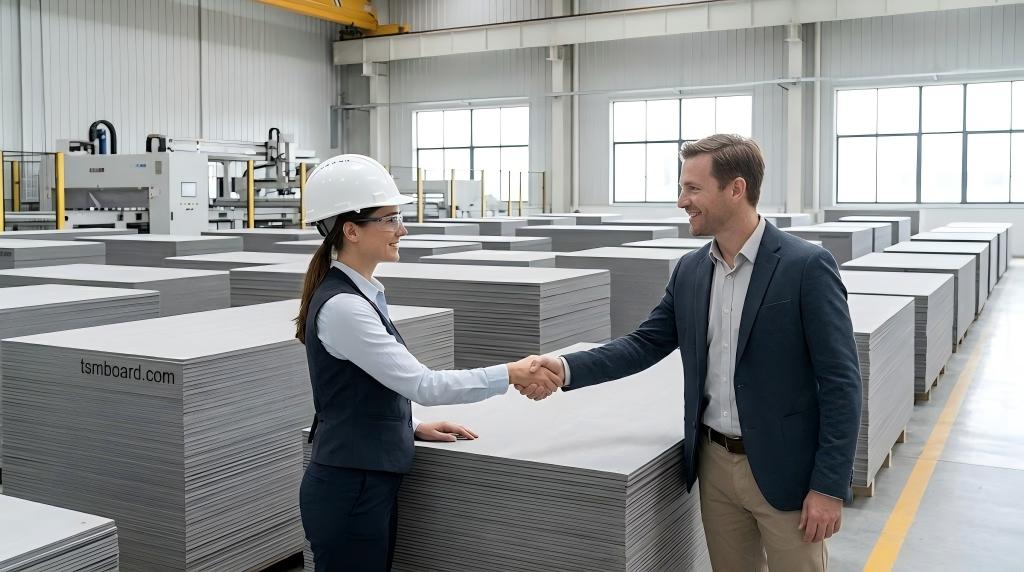
Ultimately, navigating the complex material landscape of China to identify and contract a leading reliable cement board manufacturer is an exercise in rigorous due diligence and technical verification. Procurement teams must move beyond Alibaba storefronts and audit raw material sources, technological infrastructure, quality control systems, and export compliance certifications. Securing a direct relationship w/ a proven factory ensures competitive pricing, quality consistency, and robust engineering support.
Do not compromise your project’s architectural integrity or expose your company to severe on-site liability through inferior sheathing. Build on an unyielding foundation. Explore Terasun’s comprehensive product specs and rigorous testing data. For technical consultation or factory verification regarding OEM manufacturing and Terasun global export, contact the engineering team at TSM Cement Board today, and fortify your construction supply chain w/ industry-leading non-combustible construction panels.