Skip to content
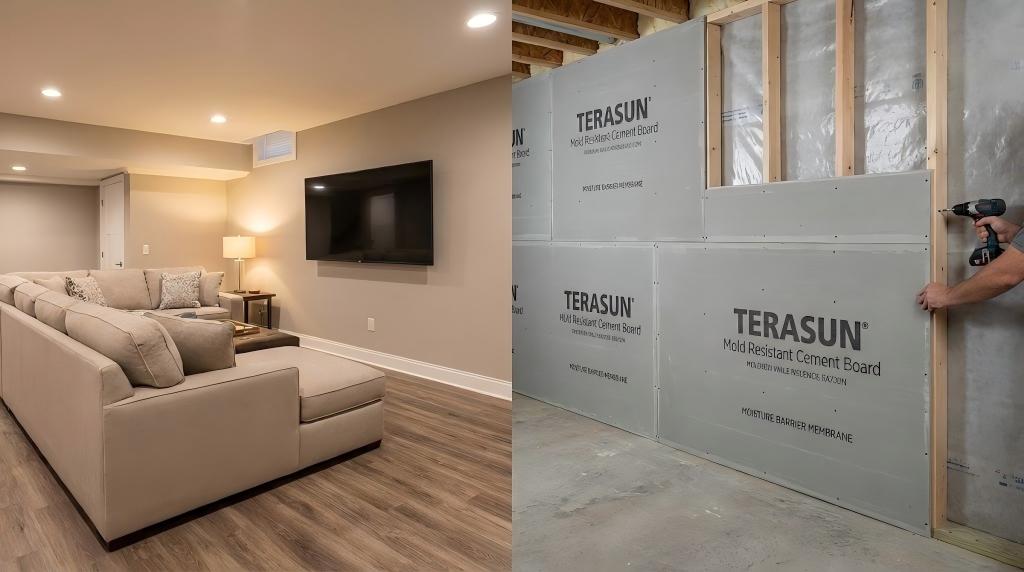
Introduction: The Hidden Threat in Subterranean Renovations
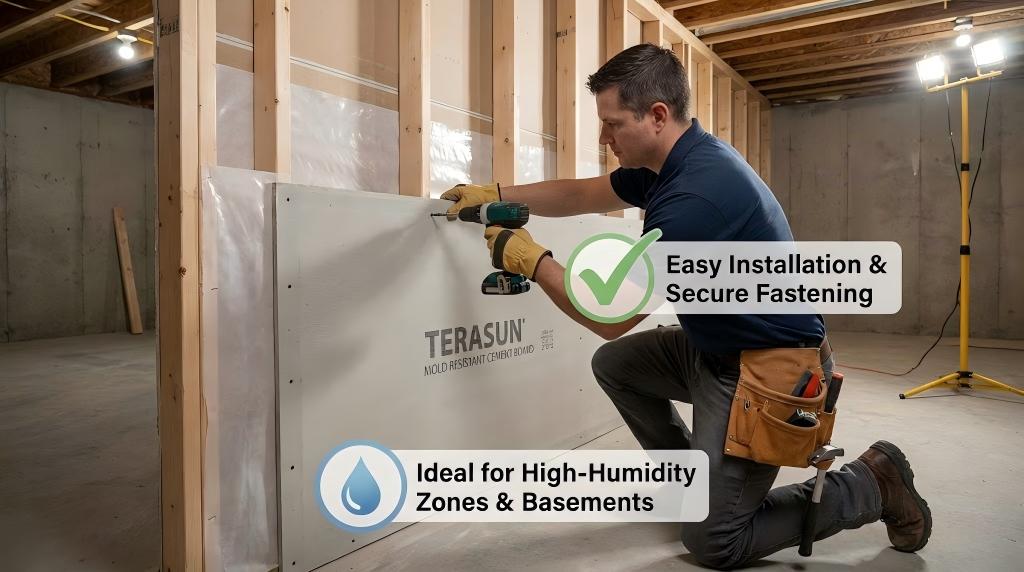
Specifying a dedicated mold resistant cement board is the most crucial preventative measure a contractor can take when finishing a subterranean space. Few scenarios in residential or commercial construction are more heartbreaking than investing tens of thousands of dollars into a basement finishing project, only to have the entire space ruined by toxic black mold just twelve months later. Unfortunately, this catastrophe occurs with alarming frequency due to a fundamental misunderstanding of subterranean building physics.
Basements exist in a constant state of environmental vulnerability. Concrete foundations are inherently porous. Consequently, hydrostatic pressure from the surrounding soil relentlessly pushes moisture vapor through the foundation walls and into the finished living space. When contractors utilize traditional, organic building materials—such as paper-faced drywall or standard plywood—they inadvertently introduce a massive food source into a naturally damp environment. This combination inevitably triggers rapid fungal growth and attracts destructive pests.
Therefore, professional builders must fundamentally change their approach. By utilizing an advanced basement renovation board, you permanently eliminate the biological risks associated with below-grade construction. In this comprehensive technical guide, we will analyze the biological mechanisms of mold and termites, deconstruct the chemical properties of advanced cementitious substrates, and outline the strict installation protocols required to build a permanent, healthy basement envelope.
The Biology of Mold and Termites in Buildings
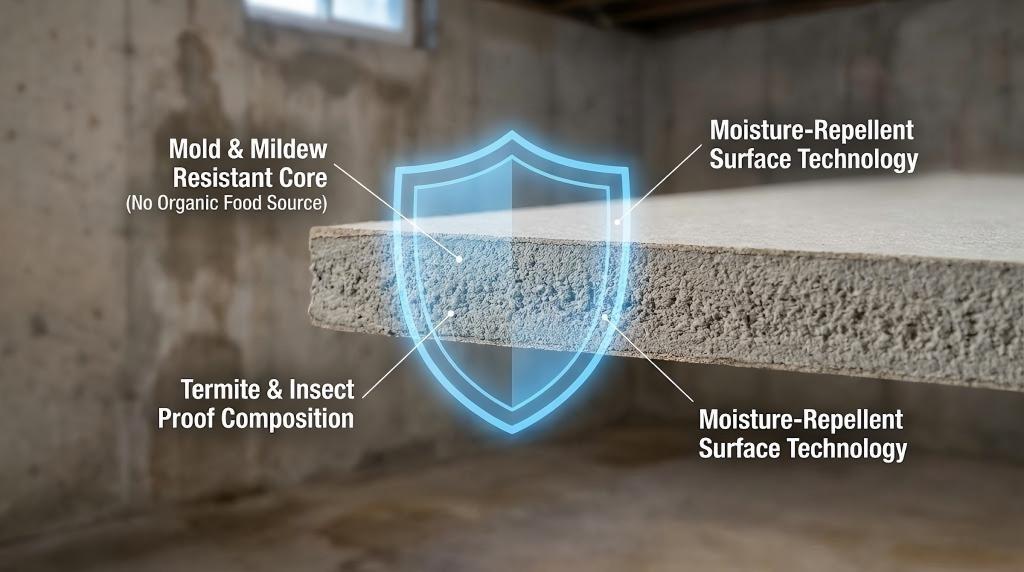
To understand why traditional materials fail so spectacularly in basements, we must first examine the biological requirements of the organisms that destroy them. Both fungi and subterranean termites operate as nature’s recycling engines; they exist to break down dead organic matter.
The Mold Triangle: Moisture, Temperature, and Cellulose
Mold spores (including dangerous strains like Stachybotrys chartarum, commonly known as black mold) exist everywhere in the ambient air. However, these microscopic spores remain dormant until they encounter the ‘Mold Triangle’—a specific combination of high relative humidity (above 60%), moderate temperatures, and a carbon-based food source. Unfortunately, traditional paper-faced drywall provides the ultimate buffet. The paper facing consists entirely of processed cellulose. When moisture vapor from the concrete foundation condenses inside the wall cavity, the drywall paper absorbs it, creating the perfect biological incubator. Within 48 hours of moisture exposure, the spores germinate, rapidly colonizing the interior wall space and releasing toxic mycotoxins into the building’s HVAC system.
Subterranean Termite Foraging Mechanics
Similarly, subterranean termites pose a massive threat to basement renovations. These highly destructive insects live in the soil outside the foundation. They build mud tubes up the concrete walls specifically searching for moisture and cellulose-rich materials. If they breach the foundation and discover standard drywall or wooden studs, they will systematically consume the structure from the inside out, often causing thousands of dollars in hidden damage before the homeowner detects any visual evidence. Consequently, contractors must specify termite proof building materials to effectively starve these pests and halt their advancement.
The Science of Mold Resistant Cement Board
To combat these biological threats, the construction industry relies on advanced material engineering. High-performance cement boards disrupt the biological lifecycle of pests and fungi through two distinct physical and chemical properties.
Removing the Biological Food Source
The primary defensive mechanism of a premium mold resistant cement board is its completely inorganic composition. Manufacturers engineer these boards using a dense matrix of Portland cement, fine silica sand, and alkali-resistant fiberglass mesh. Because the manufacturing process introduces absolutely zero paper, wood pulp, or gypsum, the finished product contains zero cellulose. Even if the basement suffers a catastrophic flood and the board becomes fully saturated, mold spores simply cannot germinate on the surface because there is no carbon-based food to sustain them. Similarly, termites find the material completely indigestible and physically impenetrable.
The Alkaline Defense Mechanism
Furthermore, Portland cement possesses inherently hostile chemical properties. Fungi generally prefer neutral to slightly acidic environments to thrive (typically a pH range of 5.0 to 7.0). In stark contrast, high-quality cement boards are highly alkaline, often registering a pH level above 11. This elevated alkalinity creates a chemically toxic environment for fungal spores, actively neutralizing their ability to establish a colony. By maintaining this high pH, the board provides passive, continuous protection without relying on the temporary chemical biocides sprayed onto ‘green’ moisture-resistant drywall.
Protection Comparison Table: Analyzing Basement Substrates
When designing a subterranean envelope, architects and contractors must evaluate substrates based on their performance under chronic moisture stress. The following table contrasts advanced cement boards against standard options.
| Material Type | Mold Resistance | Termite Resistance | Water Degradation | Impact Resistance |
| TSM Cement Board | Exceptional (Inorganic & Alkaline) | 100% Proof (Indigestible) | Zero (Maintains structural integrity) | High (Withstands heavy impacts) |
| Green Drywall (Moisture Resistant) | Moderate (Paper facing eventually feeds mold) | Low (Termites eat paper facing) | High (Gypsum core crumbles when wet) | Low (Easily punctured) |
| Standard Drywall | Very Poor (Highly susceptible) | Very Poor (Highly susceptible) | Extreme (Disintegrates rapidly) | Low (Easily punctured) |
| Standard Plywood / OSB | Poor (Wood fibers feed mold) | Poor (Termites consume wood) | High (Swells, warps, and rots) | Moderate (Can delaminate) |
As the engineering data explicitly demonstrates, standard and ‘moisture-resistant’ drywalls remain biologically vulnerable. Therefore, utilizing an engineered anti-fungus cement panel is the only statistically reliable method for securing a permanent, healthy basement environment.
Best Practices for High-Humidity Renovations
Procuring the correct inorganic material is merely the first step. To guarantee a flawless execution, contractors must follow strict building science protocols during the installation phase to manage vapor drive and bulk moisture.
Establishing Capillary Breaks
Concrete floors routinely absorb ground moisture through capillary action. If contractors rest the cement board directly on the concrete basement slab, the board will continuously wick moisture upward into the wall cavity. To prevent this, installers must maintain a strict 1/2-inch to 3/4-inch gap between the bottom edge of the board and the concrete floor. This physical gap acts as a permanent capillary break. Furthermore, utilizing durable interior walls ensures that even if minor flooding occurs, the structural integrity of the lower wall assembly remains uncompromised.
Integrating Vapor Retarders and Insulation
Basement walls require careful thermal and moisture management. Contractors should apply closed-cell spray foam insulation or rigid XPS foam board directly against the concrete foundation walls. These materials provide a continuous thermal break and act as a Class II vapor retarder. Next, contractors install the metal or pressure-treated wood framing in front of the foam. Finally, they mount the high humidity wall solutions onto the framing. This assembly prevents warm interior air from reaching the cold concrete and condensing into liquid water.
Proper Fastening and Joint Treatment
When securing the panels, installers must avoid standard drywall screws, which will rust rapidly in a damp basement environment. Instead, utilize specialized, ceramic-coated or stainless steel cement board screws. Fasten the panels every 8 inches along the studs. To finish the seams, apply alkali-resistant fiberglass mesh tape and embed it with a high-quality polymer-modified thin-set mortar. Do not use standard paper tape or standard drywall joint compound, as these organic materials will reintroduce a mold food source into the joints.
FAQ: 6 Essential Questions for Homeowners and Builders
1. Is the cement board 100% mold-proof?
Yes, the board itself is completely immune to mold growth because it contains zero organic material. However, if dust, dirt, or organic debris accumulates heavily on the surface of the board, mold can technically grow on that dirt layer. Keeping the surface clean and painted ensures absolute protection.
2. Do termites eat fiber cement materials?
No. Subterranean termites require cellulose to survive. Because Portland cement and fiberglass mesh contain no cellulose, the material is completely indigestible to them. It acts as a physical barrier that they cannot chew through to reach the interior of the home.
3. Can I paint directly over the board for a finished basement look?
Yes. While it is commonly used as a tile backer, you can achieve a smooth, painted finish. You must tape the seams with mesh, apply a skim coat of specialized moisture-resistant setting compound to achieve a Level 4 finish, and then apply a high-quality masonry primer followed by an exterior-grade acrylic paint.
4. Is it functionally better than ‘green board’ (moisture-resistant drywall)?
Significantly better. ‘Green board’ is simply standard gypsum drywall covered in water-repellent paper. If the paper gets scratched, or if the board is subjected to continuous high humidity or bulk water, the gypsum core will quickly crumble and the paper will grow mold. Cement board remains structurally intact regardless of water exposure.
5. Does the board provide thermal insulation for cold basement concrete walls?
No. Cement board is a highly dense structural cladding material; it possesses a very low R-value. It is not designed to insulate. You must pair the cement board with appropriate thermal insulation (like closed-cell spray foam or rigid XPS board) installed inside the wall cavity behind the cement board.
6. Is it safe for indoor air quality regarding VOC emissions?
Yes, it is exceptionally safe. Premium cement boards are manufactured without formaldehyde, glues, asbestos, or hazardous volatile organic compounds (VOCs). Because they are inert, they do not off-gas toxic chemicals into the enclosed basement environment, making them ideal for individuals with chemical sensitivities or asthma.
Conclusion: Protect Your Subterranean Investment
Finishing a basement is a massive financial and emotional investment. Attempting to save a minimal amount of money by utilizing organic, vulnerable drywall in a high-risk subterranean environment is a critical architectural error. The physics of hydrostatic pressure and the biology of mold dictate that below-grade spaces require specialized defense mechanisms.
By mandating the use of a true mold resistant cement board, you secure the structural envelope, protect your indoor air quality, and permanently prevent catastrophic moisture failures. Do not leave your basement renovation to chance. Explore our comprehensive range of interior applications today, and build your next project with uncompromising resilience.