Skip to content
Introduction: The Hostile Environment of the Aquatic Envelope

In the construction of high-end outdoor aquatic features, the structural envelope surrounding a swimming pool presents the most demanding mechanical and chemical challenges, making the specification of a premium moisture resistant cement board a paramount structural prerequisite. Traditional outdoor deck substrates, ranging from concrete slabs to plywood sub-floors in elevated designs, relentlessly succumb to the merciless forces present in these zones. Chlorine-saturated water aggressively attacks standard building materials, causing rapid corrosion, delamination, and severe water rot. Ground movement and freeze-thaw cycles introduce immense kinetic stress, fracturing rigid finishes. Furthermore, chronic saturation in shaded areas promotes biological nurseries for toxic mold, compromising safety and aesthetics.
Catastrophic failure in pool surrounds is rarely instantaneous; it is a creeping, expensive degradation of the underlying substrate. When water breaches the tile, stone, or paver finish, it aggressively saturates organic backing materials. Paper-faced gypsum, standard wood pulp, or improperly cured concrete swell and disintegrate. This substrate failure decouples the final paving finish, leading to extensive cracking, hazardous lippage (uneven height), and costly remediation that destroys the property owner’s investment.
Therefore, architects and heavy-duty aquatic contractors universally abandon organic or standard-duty materials in favor of advanced, inorganic cement panels. By utilizing unyielding water resistant building materials, builders permanently halt ground vapor drive, chlorine corrosion, and biological rot. In this comprehensive technical guide, we will deconstruct the Portland cement matrix, explore strict [outdoor spa construction] protocols, and demonstrate exactly why engineered, extruded cement panels are the ultimate defense for severe outdoor wet environments.
Core Physics & Material Advantages

To comprehend why premium cementitious panels flawlessly survive decades of continuous chemical saturation and freeze-thaw kinetics, we must examine the specific molecular physics and chemical composition of the substrate. A high-performance board must simultaneously resist water absorption and provide massive shear strength to support heavy stone tiles.
The Inorganic Portland Cement Matrix
Manufacturers formulate TSM cement board utilizing a highly compressed matrix of pure Portland cement, fine silica sand, and reinforcing fiberglass mesh. Unlike traditional drywall, which relies on pulverized gypsum cores, wood pulp fibers, or paper facings, these advanced boards contain absolute zero organic cellulose. Because fungi, mildew, and termites physically require a carbon-based food source to germinate, the inorganic cement matrix is inherently immune to mold growth and pest infestation. Even if the board is completely submerged in water or buried under heavy pavers for decades, biological spores physically cannot germinate on its alkaline surface.
Dimensional Stability and Freeze-Thaw Resistance
The most dangerous force acting upon an outdoor deck is not direct water saturation; it is the kinetic force generated during freeze-thaw cycles. When standard wood substrates absorb moisture, they suffer from extreme hygroscopic expansion—they swell, warp, and buckle. When that trapped water freezes, it expands by 9%, tearing the material apart at a molecular level. Conversely, a high-density, highly compressed cement matrix maintains absolute dimensional stability. It does not swell, warp, or delaminate when subjected to extreme temperature shifts. This profound dimensional integrity ensures that the rigid pool deck substrate remains perfectly static, preventing the shear forces that fracture paver stones and grout lines.
Chemical Resilience Against Chlorine and Salt
Swimming pool water is inherently aggressive. Whether treated with standard chlorine, bromine, or modern saltwater chlorination systems, the water is a corrosive solution designed to kill biological organisms. This same solution relentlessly attacks standard concrete slabs and wooden sub-floors, accelerating chemical degradation and rotting fasteners. An elite wet area wall panels possesses a profound alkaline resistance. It does not react to chlorine or saltwater exposure, guaranteeing that the chemical composition of the panel remains intact throughout the product’s lifespan.
Critical Applications & Real-World Use Cases
The immense structural rigidity and profound moisture immunity of extruded cement panels allow contractors to deploy them across the most demanding, high-risk architectural zones within the aquatic landscape. Engineers utilize these substrates wherever chronic water exposure is guaranteed.
Commercial Pool Decks and High-Traffic Coping
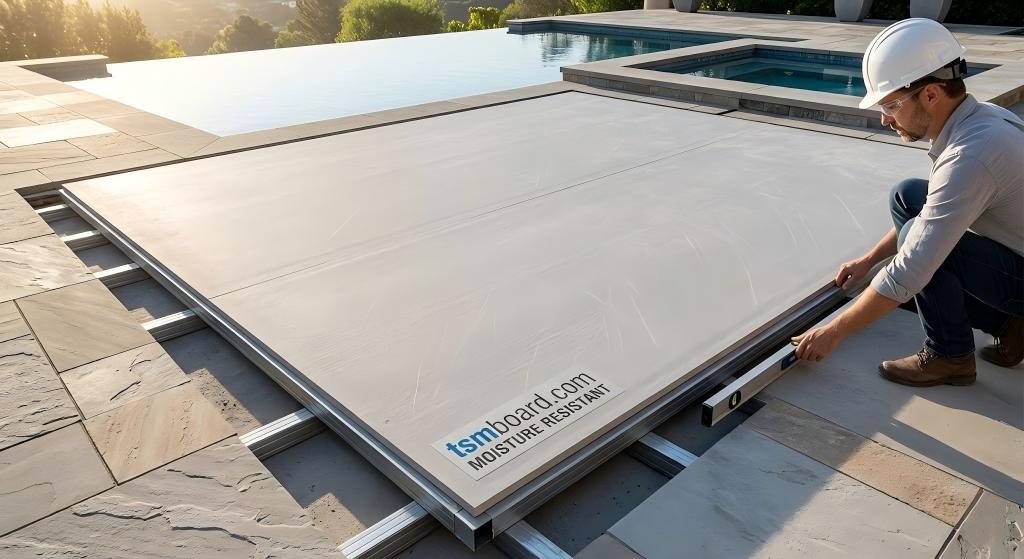
In luxury resorts, community water parks, and public fitness centers, pool decks must endure continuous, high-volume saturation and aggressive chemical washdowns multiple times a day. Standard concrete slabs frequently crack under these conditions, creating hazardous trip points. Therefore, contractors strictly specify a heavy-duty pool deck substrate to act as the primary structural decoupler. The board is installed directly beneath the paver finish. By absorbing the structural stress of ground movement below, the cement board guarantees the crack-free stability required in high-traffic commercial aquatic environments.
Custom Outdoor Spas, Jacuzzis, and Hot Tubs
Custom-built outdoor spas generate massive thermal expansion and intense vapor drive. The internal walls and benches of the spa must simultaneously support extreme water weight and resist the thermodynamic force of the heated water vapor. historical construction methods utilizing plywood shells often lead to catastrophic failure. Consequently, builders universally rejection organic shells, transitioning to engineered outdoor spa construction using unyielding cement panels. When fastened to steel framing, the cement board forms a monolithic, non-rotting core that supports intricate glass mosaics, custom natural stone coping, and the massive hydrostatic pressure of the water feature.
Rainscreen Sheathing for External Wet Environments
Aquatic facilities often include accent walls and shower enclosures that are subjected to continuous high-humidity environments. Utilizing standard drywall—even ‘green board’ (moisture-resistant gypsum)—on these external walls is negligent engineering. Therefore, architects strictly specify these highly capable cement panels as the sheathing substrate. The board serves as the rigid canvas behind stone veneer, stucco finishes, or heavy tiles, acting as unyielding high humidity wall solutions that guarantee moisture vapor does not penetrate the building’s primary structural envelope.
Comparison Table: Evaluating Aquatic Substrates
When designing a high-value aquatic envelope, architects must objectively evaluate the specific failure thresholds of various building materials. The following table mathematically contrasts advanced cement boards against concrete slabs, standard plywood, and MDF.
| Material Type | Moisture & Chlorine Resistance | Dimensionally Stable (Freeze-Thaw) | Structural Load for Stone/Pavers | Risk of Mold/Termites |
| TSM Cement Board | 100% Waterproof (Inorganic cement). | Excellent (Zero hydro-expansion). | Extremely High (Prevents paver shearing). | Zero (Contains no cellulose). |
| Concrete Slab | Limited (Difficult to decouple from ground). | Poor flexibility; highly susceptible. | High (Until it eventually cracks). | Zero (Requires no organic fibers). |
| Standard Plywood | Poor (Delaminates and rots rapidly). | Very Poor (Swelling and delamination). | Moderate (When dry), but deflects. | Extremely High (Food source). |
| MDF (Fiberboard) | Terrible (Disintegrates when wet). | Worst (Irreversible volumetric swelling). | Terrible (Zero wet strength). | Highly Combustible; food source. |
As the mechanical data explicitly demonstrates, traditional building materials are fundamentally incompatible with high-humidity external environments. For compromise life safety and asset protection, utilizing an inorganic, moisture resistant tile substrate is the only mathematically sound engineering decision.
Installation Best Practices & Engineering Specs
Procuring an immune-level substrate is merely the first phase; executing a flawless installation dictates the ultimate success of the aquatic finish. Contractors must strictly adhere to structural engineering protocols to manage building deflection and ground movement.
Deck Framing and Decoupling Requirements
Cement board must be secured to a rigid framework. For horizontal pool decks or elevated spa shells, structural engineers mandate that the wooden or steel framing studs must be spaced no more than 16 inches on center (O.C.). If the framing spacing exceeds this limit, the deck will bend, instantly cracking the Pavers or stone finish above. When installing over concrete, the cement board acts as a decoupling layer, separating the fragile finish from the dynamic cracks in the concrete slab.
Precision Fastening protocols
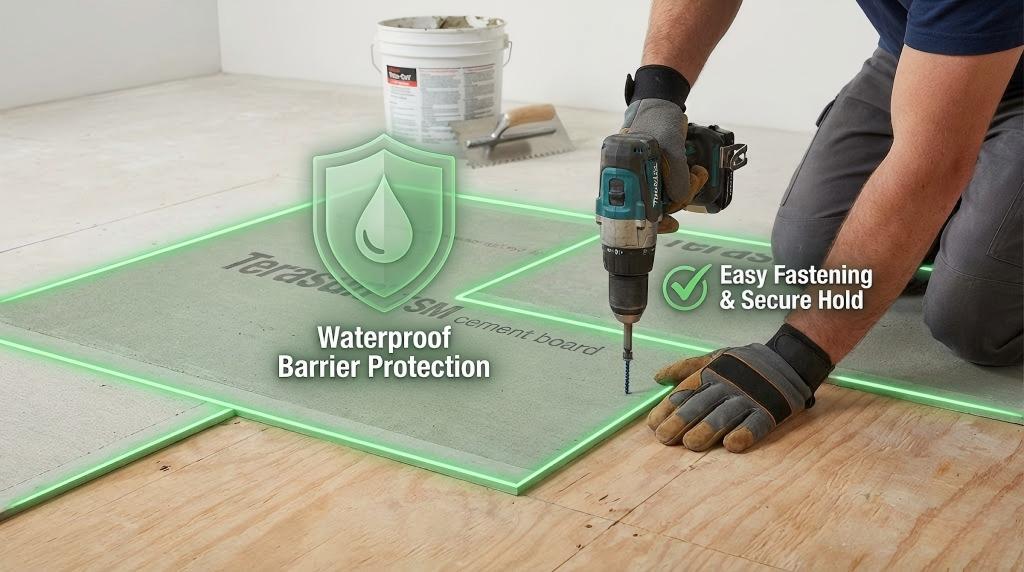
Installers must never use standard drywall screws, galvanized wood screws, or non-coated nails in an aquatic zone. The presence of chlorine, water, and oxygen creates an aggressive corrosive solution. Therefore, contractors strictly utilize specialized, alkali-resistant, ceramic-coated screws. These fasteners must be driven perfectly flush with the board’s surface and spaced precisely every 8 inches along theperimeter and internal structural members.
Joint Treatment for Monolithic Strength
To guarantee absolute structural continuity and create a perfectly monolithic water barrier across massive deck areas, the joints must be treated meticulously. Installers must leave a standardized 1/8-inch expansion gap between all board edges to absorb kinetic stress. Subsequently, they must fill this gap with a high-quality, polymer-modified thin-set mortar and embed a 2-inch wide alkali-resistant fiberglass mesh tape directly into the wet mortar. For spas or zero-entry pools, engineers mandate applying a secondary liquid-applied waterproofing membrane directly over the entire face of the finished Features assembly.
FAQ: 6 Technical Questions for Aquatic Contractors
1. What are the dimensional tolerances and sheet sizes available?
Premium cement boards are produced under extreme ISO 9001 quality control protocols. Thickness tolerance is rigorously held (e.g., +/- 0.5mm), while diagonal squareness is precisely calibrated. Common sheet sizes are 4ft x 8ft and 3ft x 5ft. Unlike trading companies, manufacturers like TSM Board can custom-cut sheets for large-scale B2B aquatic projects, minimizing on-site dust and waste.
2. How do you prevent silica dust during job site cutting?
Cutting cement board requires specific safety tooling. Contractors utilize utility scoring tools for straight snaps. For dynamic cuts around fixtures, building codes mandate using circular saws or angle grinders equipped with diamond blades. Furthermore, operators must strictly utilizeHEPA dust extraction vacuums attached directly to the saw and wear N95 particulate respirators to adhere to global OSHA standards.
3. Does the board require a secondary membrane in an outdoor spa walls?
Yes. While the moisture resistant cement board cannot rot, disintegrate, or swell when exposed to heated water vapor, it is water-permeable. In a continuously submerged spa internal shell, a secondary liquid-applied waterproofing membrane is structurally mandatory. This prevents water from migrating through the board and saturating the wooden framing, protecting the core structure from catastrophic decay.
4. Will freeze-thaw cycles cause the board to warp, buckle, or delaminate?No. A primary engineering advantage of an extruded Portland cement matrix is its dimensional stability. Unlike wood, which twists, standard concrete, which spalls, or MDF, which dissolves, the highly compressed cement matrix has near-zero hydro-expansion. Freeze-thaw kinetics are minimized because the water in the microscopic pores has sufficient space to expand without exerting extreme internal pressure on the dimensionally stable board.
5. What type of adhesive or mortar should be used to bond heavy paving stones?
Installers must never utilize standard construction adhesives or unmodified Type N/S mortars. In aggressive wet zones, they must utilize a high-quality, polymer-modified, thin-set mortar designed specifically for porcelain or large-format natural stone. The polymer additives provide the crucial elasticity required to absorb the kinetic stress of Ground movement and thermal expansion.
6. Can it be used horizontally over compacted sand for pavers?
This depends entirely on the project engineering and municipal building codes. While predominantly used as a decoupler over cracked concrete slabs or on elevated wooden sub-floors, some landscape architects possess proprietary systems using it over compacted sand to create a flawless, dimensionally stable base, preventing ground settling trip points. Always consult the engineer and municipal [Applications] code specifications.
Conclusion: Engineering Permanent Aquatic Moats
Ultimately, the longevity, physical safety, and aesthetic beauty of a custom outdoor aquatic feature depend entirely on the hidden substrates supporting the unyielding Paver finish. Attempting to reduce upfront construction capital by utilizing highly vulnerable concrete slabs or rapidly rotting wood sheathing guarantees paver lippage, grout failure, and toxic mold exposure, destroying the investment.
By mandating the use of a true moisture resistant cement board, landscape architects and heavy aquatic contractors establish an unyielding structural core immune to chlorine corrosion, ground movement, and biological decay. Do not compromise the structural integrity of your high-value aquatic feature. Secure your pool decks and spa environments with industry-leading materials. Explore our comprehensive testing certifications, detailed dimensional specs, and interlink to homepage, sub-pages by visiting the Applications page at TSM Cement Board today to build your next project with absolute certainty.