Skip to content
Introduction: The Foundation of Flawless Flooring

Selecting the right cement board underlayment for tile is the single most critical decision you will make when planning a durable flooring project. When contractors install beautiful ceramic, porcelain, or natural stone tiles directly over wooden subfloors or weak oriented strand board (OSB), failure is almost guaranteed. Specifically, the natural expansion, contraction, and deflection of organic wood inevitably lead to cracked grout lines, popping tiles, and costly callbacks.
Consequently, building a rigid, dimensionally stable, and moisture-resistant foundation is absolutely essential. Wood absorbs ambient moisture and flexes under foot traffic. In contrast, an engineered flooring substrate provides an unyielding, flat surface that isolates the rigid tile from the moving structural framing below.
In modern commercial and residential construction, industry professionals no longer gamble with inferior backing materials. Therefore, making the switch to a high-performance substrate is a non-negotiable standard. In this comprehensive guide, we will explore the profound technical benefits of utilizing TSM cement board, compare it directly against outdated alternatives, and walk you through the precise installation techniques required to guarantee a floor that lasts a lifetime.
What is Cement Board Underlayment for Tile?
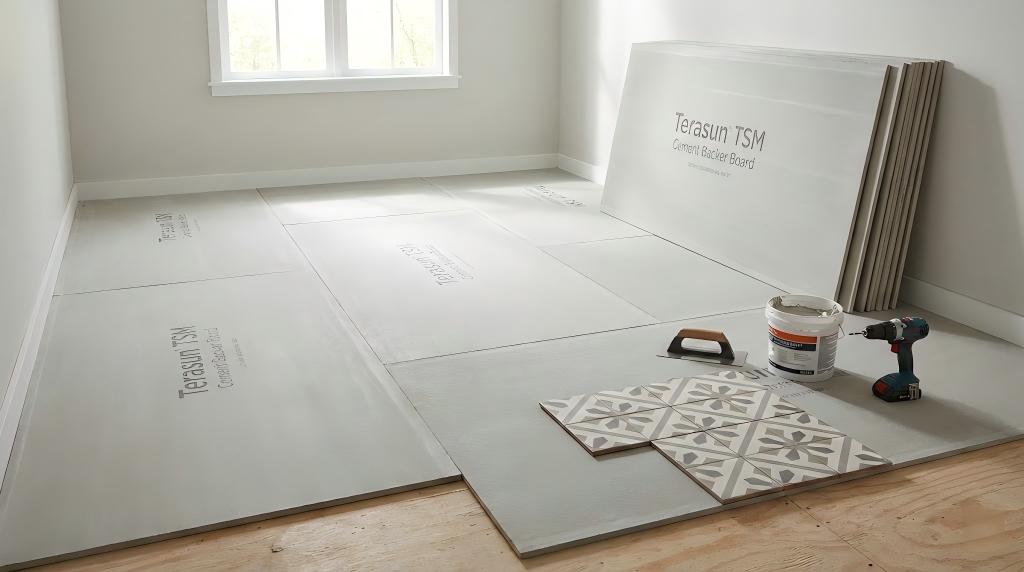
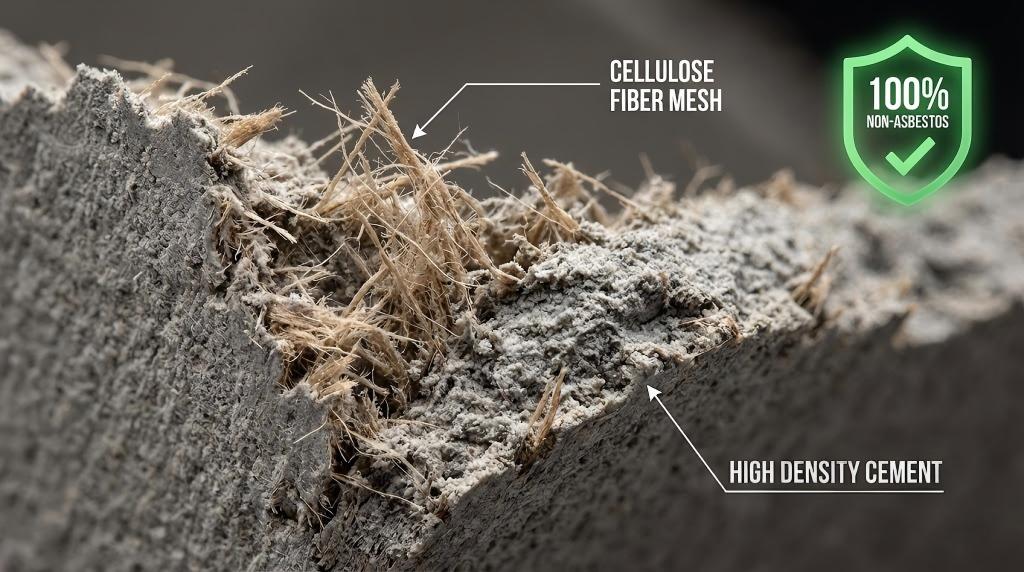
To truly appreciate its value, you must first understand the material science behind the product. At its core, a high-quality cement board underlayment is an engineered panel manufactured from a homogenous mixture of Portland cement, fine sand, and water, heavily reinforced with fiberglass mesh on both its upper and lower surfaces.
This specific combination creates a structural matrix that is exceptionally dense and incredibly rigid. Unlike gypsum-based products that crumble when exposed to water, or plywood that swells and rots, a true TSM cement board subfloor remains completely inert. Furthermore, Terasun’s proprietary manufacturing process cures these boards under immense pressure and high temperatures, ensuring maximum dimensional stability.
As a result, the board acts as a flawless structural bridge. It effectively absorbs the microscopic movements of the wooden joists below, preventing that kinetic energy from transferring upward into the brittle tile layer above. Moreover, because the material contains absolutely no organic compounds, it is fundamentally immune to the biological degradation that plagues traditional building materials. Ultimately, choosing a premium cement board underlayment for tile is the ultimate insurance policy for your flooring investment.
Top 4 Technical Benefits for Tile Floors
Why has this specific material become the gold standard for architects and tile setters worldwide? The answer lies in four distinct performance advantages that directly solve the most common flooring failures.
1. Unmatched Water Resistance
Water is the ultimate enemy of building materials. In wet areas like bathrooms, kitchens, and entryways, water frequently seeps through microscopic cracks in grout lines. If this moisture reaches a plywood subfloor, the wood swells, breaking the mortar bond and lifting the tile. However, a premium moisture-resistant underlayment like TSM does not swell, warp, or lose structural integrity even when completely submerged. It essentially stops moisture-related flooring failures in their tracks.
2. Maximum Structural Rigidity (Deflection Control)
The Tile Council of North America (TCNA) dictates that a floor must meet a minimum deflection standard of L/360 to support ceramic tile. Deflection refers to how much the floor bounces under weight. If a floor bounces, the tile cracks. Cement boards add immense stiffness to the subfloor assembly. Consequently, they distribute heavy point loads (like kitchen islands or cast-iron bathtubs) evenly across the joists, ensuring the floor remains absolutely rigid and the tiles stay perfectly intact.
3. Absolute Mold and Termite Resistance
Dark, damp spaces trapped beneath flooring are breeding grounds for toxic black mold and destructive termites. Because traditional plywood and paper-faced drywall contain cellulose, they provide a continuous food source for these organisms. In stark contrast, an inorganic floor tile base starves them. You completely eliminate the risk of fungal growth and insect infestation, which drastically improves indoor air quality and structural longevity.
4. Optimal Thermal Stability for Underfloor Heating
Radiant underfloor heating systems are increasingly popular in modern construction. These systems generate rapid temperature fluctuations that cause standard wood subfloors to expand and contract violently. TSM boards, however, possess excellent thermal mass and stability. They conduct heat efficiently upward into the tile while resisting the thermal expansion that typically causes mortar to shear.
Comparison Table: TSM Cement Board vs. Plywood vs. Drywall
To make an informed engineering decision, you must analyze the hard data. The following table directly compares our advanced substrate against traditional alternatives across critical performance metrics.
| Performance Metric | TSM Cement Board | Standard Plywood (Exterior Grade) | Green Drywall (Moisture Resistant) |
| Material Composition | Portland Cement & Fiberglass | Organic Wood Veneers & Glue | Gypsum Core & Treated Paper |
| Water Resistance | Excellent (No swelling or rot) | Poor (Swells, warps, and rots) | Very Poor (Crumbles when wet) |
| Mold Resistance | 100% Inorganic (Zero mold growth) | Low (Susceptible to fungal attack) | Low (Paper facing feeds mold) |
| Load Bearing Rigidity | Extremely High (Prevents deflection) | Moderate (Prone to bending) | Negligible (Non-structural) |
| Fire Safety Rating | Class A1 (Completely Noncombustible) | Combustible (Adds to fire load) | Limited Combustible |
| Lifespan in Wet Areas | 50+ Years | 5 to 10 Years | < 5 Years |
As the data clearly illustrates, while plywood might offer a lower initial purchase price, its failure rate in moisture-prone environments guarantees a negative return on investment. Therefore, standardizing your projects with high-quality advanced cement boards is the only mathematically logical choice for professional builders.
Step-by-Step Installation Best Practices
Purchasing the right material is only half the battle; proper execution dictates the final result. Many contractors skip crucial steps to save time, which ultimately causes the flooring to fail. Follow this meticulous installation guide to ensure perfect results.
Step 1: Subfloor Preparation and Assessment
Before you begin, thoroughly inspect the existing wooden subfloor. Verify that the floor joists are spaced no more than 16 inches on center. Additionally, secure any loose plywood panels with decking screws to eliminate squeaks. Sweep and vacuum the entire area. The surface must be completely free of dust, oil, and debris, because contaminants will ruin the mortar bond.
Step 2: Applying the Thin-Set Mortar
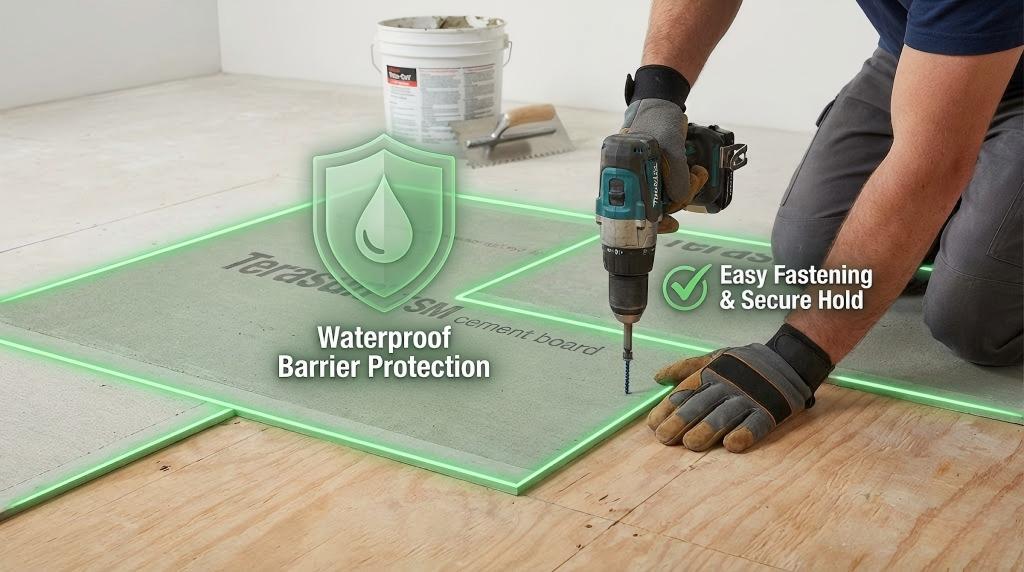
This is the most misunderstood step in the industry. You must trowel a layer of modified thin-set mortar directly onto the plywood subfloor *before* laying the cement board. Crucially, this mortar does not act as a glue. Instead, it acts as a void-filler. It fills the microscopic gaps between the imperfect wood subfloor and the rigid board, ensuring 100% continuous support. Without this mortar layer, the board will flex under heavy footsteps, which will eventually crack the tile above.
Step 3: Laying and Spacing the Boards
Place your cement board thickness panels flat into the wet mortar. Always stagger the joints in a brick-work pattern so that four corners never meet at a single point. Furthermore, leave a 1/8-inch expansion gap between the edges of the boards, and a 1/4-inch gap along the perimeter walls. These small gaps accommodate micro-movements in the building’s foundation.
Step 4: Fastening the Panels
Do not use standard drywall screws, as the alkaline nature of cement will quickly rust them. Instead, utilize specialized, corrosion-resistant cement board screws (typically 1-1/4 inches long). Drive a screw every 8 inches across the entire face of the board. Ensure the screw heads sit perfectly flush with or slightly below the surface of the board.
Step 5: Taping the Seams
Finally, you must bridge the gaps between the boards to create a unified, monolithic structure. Apply self-adhesive, alkali-resistant fiberglass mesh tape over all the joints. Subsequently, use a flat trowel to embed the tape with a thin layer of modified thin-set mortar. Feather the edges smoothly so you do not create raised bumps that will throw your floor tiles out of level.
FAQ: 6 Common Flooring Questions Addressed
1. Do I absolutely need thin-set under my cement board underlayment for tile?
Yes, unequivocally. As explained earlier, the thin-set mortar eliminates microscopic air voids between the wood subfloor and the rigid cement board. If you skip this step, the board will flex slightly when you walk on it. Eventually, this continuous flexing will cause your expensive floor tiles and grout lines to crack.
2. Which side of the cement board goes up?
Most high-quality boards feature a smooth side and a slightly textured (or rough) side. You should always install the board with the rough side facing up. Consequently, this textured surface provides significantly more mechanical ‘bite’ or ‘grip’ for the thin-set mortar when you lay your final tiles, ensuring a vastly stronger bond.
3. Can I use this substrate for heavy natural stone tiles?
Absolutely. Natural stone tiles, such as marble, travertine, or thick slate, are incredibly heavy and brittle. They require an exceptionally rigid subfloor. TSM boards drastically reduce floor deflection, making them the perfect, uncompromising base for high-end, heavy stone flooring installations.
4. How do I cut TSM cement board cleanly on the job site?
You have two safe options. For straight cuts, use a carbide-tipped scoring tool and a straight edge. Score the fiberglass mesh deeply, then firmly snap the board along the line, just like drywall. For intricate cuts (like around toilet flanges), use an angle grinder equipped with a continuous-rim diamond blade. Always wear a specialized dust mask and cut outdoors to avoid inhaling silica dust.
5. What is the minimum thickness required for floor underlayment?
For residential and commercial floor installations over a structurally sound 5/8-inch exterior-grade plywood subfloor, the industry standard dictates using a 1/4-inch (6mm) thick cement board. Conversely, you reserve 1/2-inch (12mm) thick boards for vertical wall applications, such as inside shower enclosures.
6. Does the board require an additional waterproof membrane?
It depends entirely on the location. While the cement board itself will not rot or degrade when exposed to water, it is not a vapor barrier; water can eventually seep through it to the wood below. Therefore, in extremely wet areas like walk-in showers or commercial wet rooms, you must apply a liquid waterproofing membrane (like RedGard) over the board before installing your tile.
Conclusion: Build on a Solid Foundation
Ultimately, a beautiful tile floor is only as reliable as the substrate hiding beneath it. By prioritizing structural integrity and moisture defense, you protect your craftsmanship from inevitable environmental stress.Replacing outdated plywood with advanced inorganic paneling saves contractors money on callbacks and guarantees client satisfaction for decades. Do not compromise the foundation of your next project. Explore our comprehensive range of high-performance cement board underlayment solutions today, and elevate your construction standards to the next level.