Skip to content
Introduction: The Hostile Subterranean Environment

In the realm of residential and commercial architecture, subterranean environments present the most hostile conditions for interior finishing materials. Because basements sit below the water table, they constantly battle immense hydrostatic pressure, capillary moisture wicking, and severe water rot. To permanently defeat these architectural pain points, engineers universally mandate the installation of an anti-mold cement board during finishing phases. When contractors utilize traditional paper-faced gypsum drywall in a basement, they inadvertently install a massive biological food source directly against a chronic moisture vapor drive. This fundamental engineering error inevitably triggers catastrophic fungal growth, structural rot, and rapid indoor air quality degradation (Sick Building Syndrome).
Mold spores exist ambiently in all environments, but they remain dormant until they encounter moisture and organic cellulose. In a subterranean space, concrete foundation walls continuously wick ground moisture into the interior wall cavity. If standard drywall absorbs this moisture, the paper facing rots, and toxic black mold germinates within 48 hours. Furthermore, wood-based panels like OSB or plywood suffer from violent hygroscopic expansion, buckling the finished walls and accelerating structural failure.
Consequently, to completely insulate the building envelope against these existential threats, advanced builders transition exclusively to inorganic, cementitious substrates. By leveraging subterranean wall materials engineered specifically for below-grade applications, contractors sever the moisture-to-mold lifecycle. In this comprehensive technical guide, we will analyze the precise alkaline physics of Portland cement, evaluate its superior resilience in damp conditions, and outline the strict installation protocols required to finish a basement wall flawlessly.
Core Physics & Material Advantages

To fully comprehend why premium cement boards exhibit total immunity to fungal decay and moisture degradation, we must deconstruct the specific molecular physics and inorganic chemistry of the substrate. Preventing mold is a matter of starving the biological organism at a cellular level.
The Inorganic, Asbestos-Free Portland Cement Matrix
High-performance manufacturers formulate their TSM cement board utilizing a highly compressed, crystalline matrix of Type I Portland cement, ultra-fine silica sand, and water. Crucially, modern engineering has entirely eliminated the use of hazardous asbestos fibers. Instead, state-of-the-art facilities utilize continuous strands of alkali-resistant fiberglass mesh embedded deep within the faces of the cement core to provide massive tensile and flexural strength. Because the board consists of 100% inorganic minerals, it possesses an intrinsic, absolute immunity to biological decay. Mold, mildew, and rot fungi physically require a carbon-based food source (like paper, wood pulp, or organic resins) to survive. By eliminating cellulose from the manufacturing process, the board permanently starves the fungal lifecycle.
Alkaline pH and Chemical Spore Inhibition
Beyond merely lacking a food source, the cement board actively attacks fungal biology. Portland cement cures into a highly alkaline compound, typically registering a pH level between 11 and 13. Mycelium and fungal spores require a neutral or slightly acidic environment to germinate and spread. When airborne spores land on the alkaline surface of the cement board, the extreme pH instantly disrupts their cellular walls, physically preventing germination. This chemical attribute transforms the board into an active, permanent shield against subterranean mold proliferation.
Absolute Immunity to Subterranean Pests
Basements and crawlspaces serve as the primary entry vectors for subterranean termites, carpenter ants, and other destructive pests. These insects aggressively tunnel through standard drywall, plywood, and MDF to harvest the cellulose within. However, because Portland cement and fiberglass offer zero nutritional value and feature extreme physical density, insects cannot consume or penetrate the material. Consequently, contractors specify these termite proof boards to create an impenetrable, physical barrier that protects the upper wooden structural framing from localized ground-level infestations.
Critical Applications & Real-World Use Cases
The immense shear capacity, absolute fire immunity, and rugged environmental resilience of extruded cement panels allow contractors to deploy them across the most punishing subterranean environments. Engineers specify these heavy-duty boards wherever maximum environmental insurance is mandatory.
High-End Basement Home Theaters and Gyms
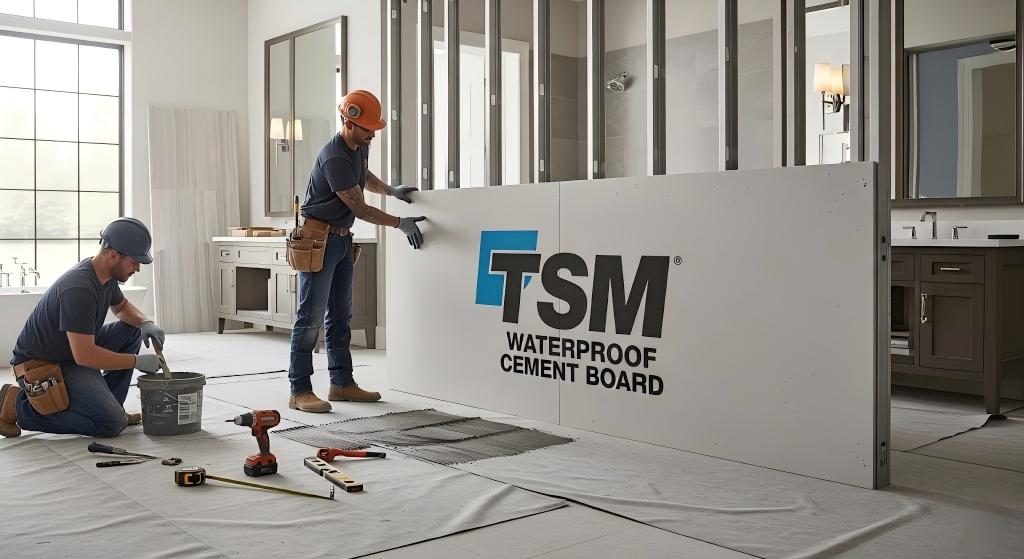
When homeowners invest tens of thousands of dollars into acoustic isolation, customized lighting, and specialized flooring for a basement home theater or underground gym, protecting that investment is paramount. Standard drywall easily succumbs to the elevated ambient humidity generated by human respiration in enclosed gyms or the moisture vapor migrating through the concrete foundation. Therefore, architects strictly specify a mildew resistant drywall alternative to line the perimeter walls. Installers mount the heavy-density cement panels directly over the perimeter steel framing. This creates an unyielding, pristine canvas that permanently protects the expensive interior paint, acoustic treatments, and millwork from hidden moisture damage.
Damp Environment Construction: Sump Pump and Utility Rooms
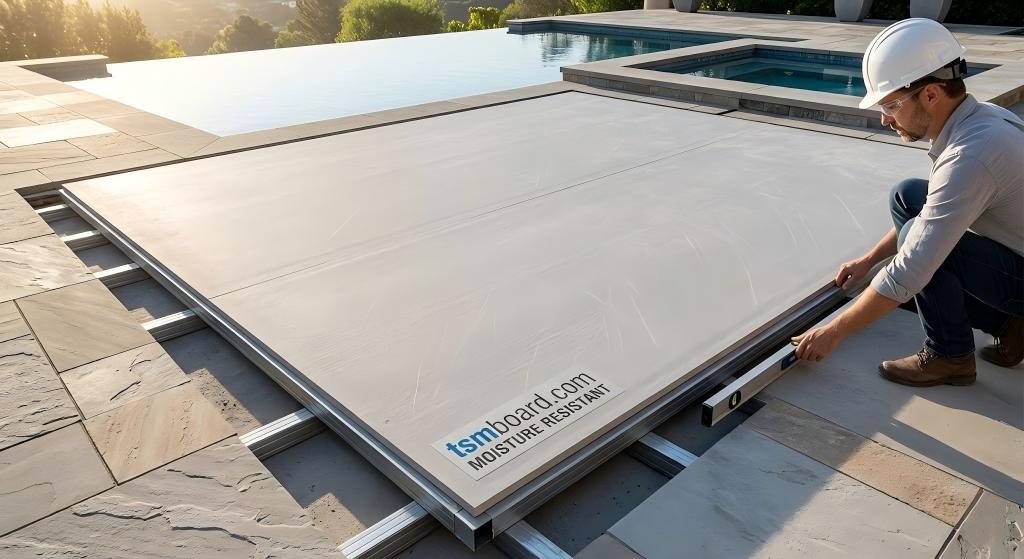
Basement utility rooms house HVAC systems, water heaters, and sump pumps. These zones represent the highest risk for accidental interior flooding and continuous high humidity. If a sump pump fails, the bottom two feet of standard drywall will wick the floodwater upward via capillary action, requiring total wall demolition. Furthermore, the constant temperature fluctuations around HVAC equipment cause severe condensation inside the wall cavities. Consequently, commercial builders utilize specialized damp environment construction protocols, installing cement boards in all utility zones. The board simply absorbs the water and dries out without losing any structural integrity, completely eliminating the need for expensive post-flood wall replacements.
Masonry Backing for Subterranean Feature Walls
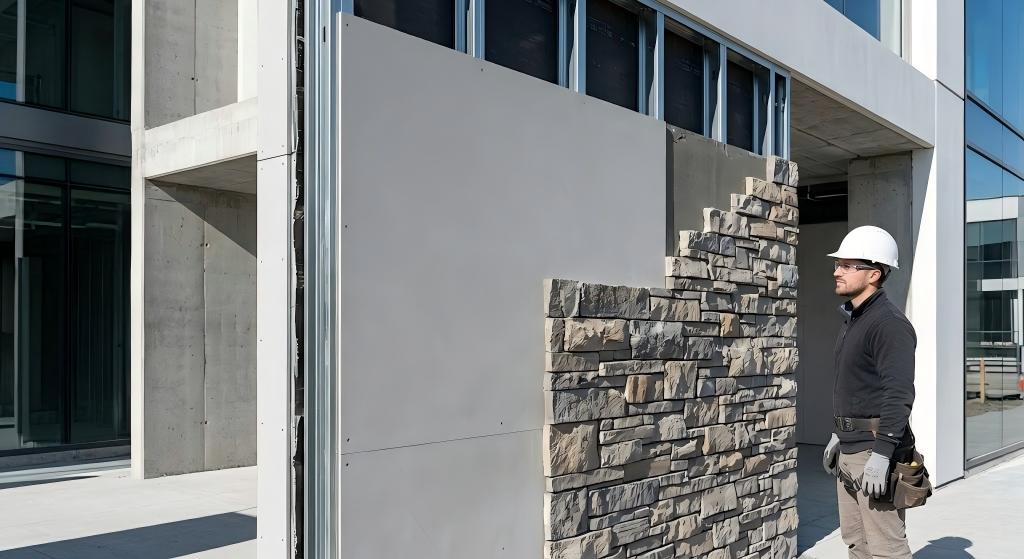
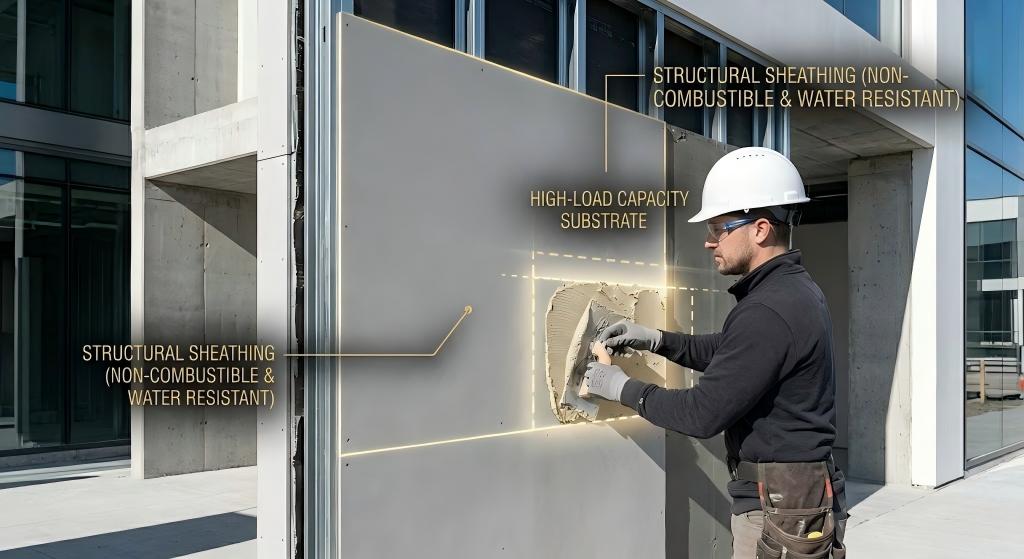
Modern basement finishing frequently incorporates heavy interior stone veneer, brick slips, or oversized porcelain tile feature walls around subterranean wet bars and fireplaces. Plywood and standard drywall lack the sheer flexural modulus to support these massive static loads. Therefore, masons utilize rigid basement finishing panels as the primary structural substrate. The Portland cement matrix grips the polymer-modified thin-set mortar with tremendous mechanical adhesion, transferring the massive dead load of the masonry seamlessly into the wall studs and preventing catastrophic shear delamination.
Comparison Table: Evaluating Basement Substrates
When engineering a wall assembly for a below-grade environment, architects must objectively evaluate the failure thresholds of various sheathing materials. The following table mathematically contrasts advanced cement boards against standard construction alternatives across critical subterranean performance metrics.
| Substrate Type | Mold & Mildew Resilience | Moisture / Flood Survivability | Fire Resistance Classification | Termite & Pest Resistance |
| TSM Cement Board | Absolute Immunity (No cellulose, high pH) | Excellent (Retains 100% strength wet) | Class A1 (100% Noncombustible) | Absolute Immunity |
| Traditional Drywall | Fails instantly; feeds mold rapidly. | Very Poor (Crumbles and dissolves). | Limited (Paper facing burns). | Low (Pests consume paper). |
| Moisture-Resistant “Green” Board | Moderate (Treated paper eventually fails). | Poor (Gypsum core still vulnerable). | Limited (Treated paper burns). | Low. |
| Standard OSB/Plywood | Poor (Feeds toxic black mold). | Poor (Swells, delaminates, rots). | Highly Combustible (Class D/E). | Zero (Primary food source). |
As the mechanical and biological data explicitly demonstrates, traditional organic building materials are fundamentally incompatible with subterranean environments. For uncompromising structural safety, utilizing a high-density TSM Cement Board is the only scientifically sound engineering decision for basement renovations.
Installation Best Practices & Engineering Specs
Procuring an elite anti-mold substrate is merely the first phase; executing a flawless installation dictates the ultimate success of the basement assembly. General contractors must strictly adhere to structural engineering protocols to manage negative-side vapor drive and ensure a permanent mechanical bond.
Perimeter Framing and Thermal Breaks
Basement foundation walls weep moisture. Therefore, contractors must never secure cement boards (or any finishing material) directly to the raw concrete foundation. Engineers mandate the installation of light-gauge galvanized steel studs or pressure-treated lumber offset at least 1 inch to 2 inches away from the foundation wall. This creates a critical capillary break and an air gap for ventilation. Furthermore, the studs must be spaced no more than 16 inches on center (O.C.) to provide rigid support and prevent deflection. Contractors routinely spray closed-cell polyurethane foam insulation against the concrete wall behind the studs to act as a permanent vapor barrier before the cement boards are attached.
Precision Fastening Protocols
Installers must never use standard drywall screws to hang cement board in a damp basement environment. The ambient moisture will rapidly oxidize standard steel screws, causing them to rust, snap, and release the heavy panels. Contractors must utilize highly specialized, alkali-resistant, ceramic-coated cement board screws. These fasteners feature self-drilling tips and nibs under the head to perfectly countersink into the dense Portland matrix. Fasteners must be driven perfectly flush with the board’s surface and spaced precisely every 8 inches along the perimeter and internal framing studs.
Joint Treatment and Surface Finishing
To create a continuous, monolithic surface ready for paint or wallpaper, the panel joints must be treated meticulously. Installers must leave a 1/8-inch expansion gap between all boards to absorb microscopic kinetic shifts in the building’s foundation. They then embed a 2-inch wide, alkali-resistant fiberglass mesh tape directly over the seams. Instead of using standard organic drywall mud (which can grow mold), contractors must fill the joints and skim-coat the board utilizing a specialized, inorganic cementitious setting compound or a polymer-modified thin-set mortar. This guarantees the entire finished wall surface remains 100% mold-proof.
FAQ: 6 Technical Questions for Basement Contractors
1. What are the exact dimensional tolerances of the anti-mold cement board?
Our high-density cement boards are manufactured under strict ISO quality control parameters. The thickness tolerance is rigorously maintained at +/- 0.5mm, and the edges are factory-cut with precise squareness. This ensures that the boards butt together perfectly on the steel framing studs without creating uneven ridges (lippage) that would complicate the final skim coating and painting process.
2. How do installers manage silica dust when cutting the board indoors?
Because the board utilizes a dense Portland cement and silica sand matrix, contractors must cut it using specific protocols. For straight cuts, the ‘score and snap’ method utilizing a carbide-tipped utility knife produces near-zero dust. For intricate cuts around basement plumbing or electrical boxes, contractors utilizing an angle grinder must employ tools equipped with active HEPA-filtered dust extraction vacuums, and must consistently wear N95 particulate respirators to comply with OSHA safety standards.
3. Does this cement board provide thermal insulation (R-Value) for the basement?
No. Cement board is a highly dense, thermally conductive mass. It possesses an extremely low R-Value and does not act as an insulator. To achieve proper thermal efficiency in a basement, contractors must install closed-cell spray foam, rigid XPS foam board, or mineral wool batts in the cavity between the concrete foundation and the back of the cement board assembly.
4. Can I paint directly over the cement board for a finished basement wall?
Yes. While it is frequently used as a hidden substrate for tile, it can easily serve as a Class A finished wall. Installers must tape the joints with fiberglass mesh, apply a skim coat of compatible cementitious setting compound to achieve a smooth Level 4 finish, and finally seal the highly alkaline surface using a specialized masonry primer before applying any premium exterior-grade acrylic or elastomeric paint.
5. Does the board comply with major international fire and building codes?
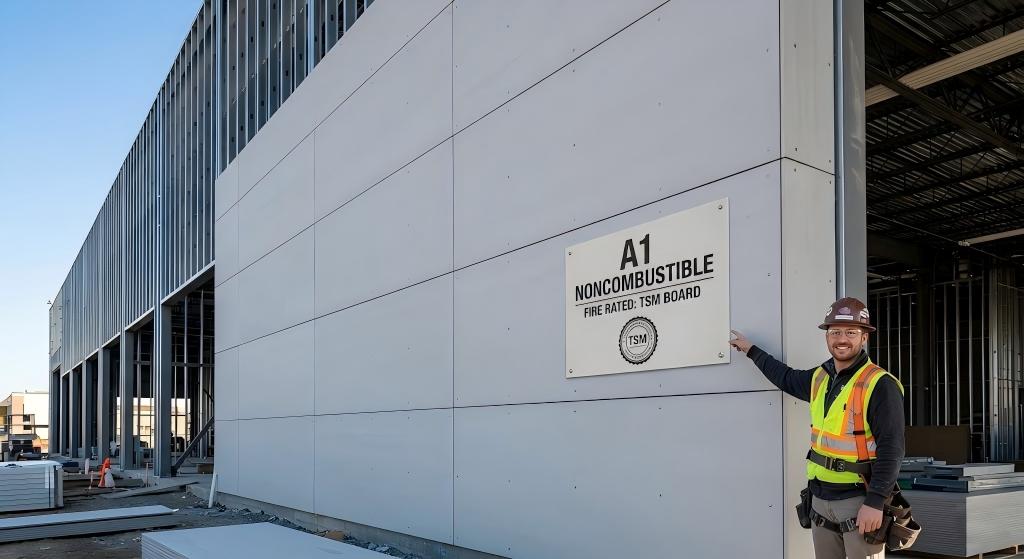
Yes. High-quality cement boards are rigorously tested and certified to meet the world’s most demanding building codes. They comply with the European CE mark, strict ASTM standards for flexural strength and moisture resistance, and carry the elite EN 13501-1 Class A1 noncombustible fire rating, guaranteeing maximum life safety in confined subterranean escape routes.
6. Do I need to install a poly plastic vapor barrier directly behind the cement board?Modern building science generally advises against installing a 6-mil poly vapor barrier directly behind the interior wall board in basements, as it can trap moisture inside the stud cavity, rotting the wood framing. It is superior to utilize a vapor-permeable documents assembly, or to manage the vapor drive at the concrete foundation wall level using closed-cell spray foam, allowing the cement board to safely breathe any ambient humidity.
Conclusion: Engineering a Permanent Subterranean Envelope
Ultimately, the aesthetic majesty, indoor air quality, and long-term safety of a finished basement are entirely dependent upon the hidden structural substrate defining the perimeter walls. Attempting to reduce upfront construction costs by applying vulnerable, organic drywall in a notoriously damp, below-grade environment is a critical architectural error that guarantees eventual catastrophic fungal decay.
By mandating the use of a premium anti-mold cement board, structural engineers and high-end contractors establish an unyielding, fireproof, and biologically immune foundation capable of enduring decades of hydrostatic pressure and vapor drive. Do not compromise the structural integrity of your subterranean renovations. Secure your basement envelope with industry-leading materials. Explore our comprehensive load-bearing specifications and detailed installation schematics by visiting the TSM Cement Board homepage, or reach out to our technical engineering team via Contact Us today to fortify your next major project.