Skip to content
Introduction: The Bedrock of Passive Fire Protection

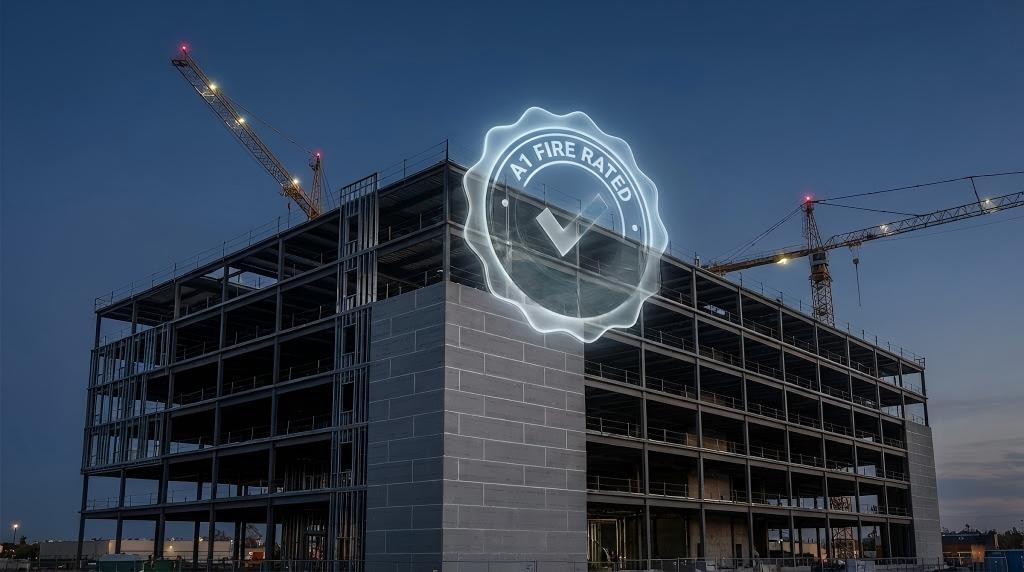
Specifying an a1 fire rated cement board represents the most critical life-safety decision an architect can execute during the structural design phase. When a devastating structural fire occurs, the physical properties of the building envelope dictate the survival rate of the occupants. Modern architecture relies heavily on two distinct categories of fire safety: active systems and passive systems. Active systems, such as sprinkler networks and mechanical smoke extractors, require electricity, water pressure, and mechanical activation. Consequently, they possess a measurable failure rate during catastrophic events.
In stark contrast, passive fire protection requires no mechanical activation. It relies entirely on the inherent physical and chemical properties of the construction materials to compartmentalize the blaze, halt flame spread, and maintain structural integrity. This is where advanced cementitious panels dominate the industry. By surrounding critical infrastructure with completely noncombustible materials, engineers buy precious time for evacuation and emergency response.
Therefore, understanding the stringent metrics of building fire codes is an absolute necessity for modern contractors. In this comprehensive technical analysis, we will demystify international fire testing standards, explore the exact physics of material combustion, and identify the mandatory applications where specifying these advanced inorganic panels saves lives and protects immense financial assets.
Demystifying the ‘A1’ Rating: The Science of Noncombustibility
Contractors frequently encounter various fire classifications, but many fail to grasp the specific thermodynamic thresholds these ratings represent. The ‘A1’ classification specifically stems from the European Standard EN 13501-1, which provides the most rigorous and universally respected reaction-to-fire assessment globally.
The EN 13501-1 Classification System
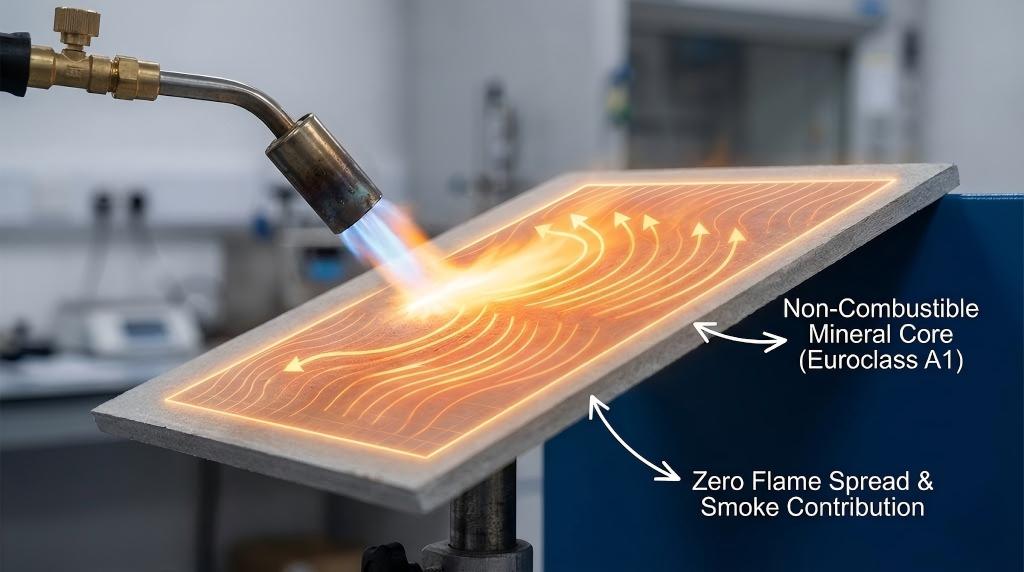
The EN 13501-1 standard evaluates materials across a spectrum from A1 (completely noncombustible) down to F (highly combustible). To achieve an A1 rating, a material must pass severe calorimetric testing. Specifically, engineers place the material in a specialized testing furnace reaching temperatures exceeding 750°C (1382°F). During this exposure, the material must not ignite, must not sustain a flame, and crucially, must not contribute any measurable thermal energy (calorific value) to the surrounding environment. An noncombustible cement board easily meets this threshold because its primary matrix consists of inorganic Portland cement and silica sand.
Zero Smoke and Zero Flaming Droplets
Furthermore, the A1 classification inherently guarantees superior performance regarding smoke toxicity and physical deterioration. When combustible materials burn, they generate dense, toxic smoke that accounts for the vast majority of fire-related fatalities. Additionally, melting plastics and resins produce flaming droplets that rapidly spread the fire to lower floors. Because A1-rated cement boards contain no organic resins or plastics, they achieve the highest possible sub-classifications for smoke production (s1) and flaming droplets (d0). They produce absolute zero toxic smoke and zero burning debris, ensuring escape routes remain clear and breathable.
Where A1 Fire Rated Cement Board is Strictly Mandatory
Municipal building codes, including the International Building Code (IBC) and local Eurocodes, dictate precisely where contractors must install noncombustible materials. Architects specify these panels to create compartmentalization zones that trap fires within their area of origin.
High-Rise Exterior Cladding and The Chimney Effect
Recent global tragedies have highlighted the catastrophic danger of combustible exterior facades. When fire breaches a window, it can rapidly travel up the exterior of a high-rise building via a phenomenon known as the ‘chimney effect.’ The gap between the cladding and the insulation acts as a flue, drawing oxygen upwards and accelerating the blaze. Consequently, building authorities now strictly mandate fireproof wall panels for all high-rise exterior sheathing. A1-rated boards prevent the vertical propagation of flames, protecting the entire structural envelope.
Elevator Shafts and Escape Corridors
Elevator shafts and stairwells serve as the central respiratory system of a building, and they are highly susceptible to vertical smoke and fire spread. Contractors must construct these vertical shafts using materials that maintain rigid structural integrity under extreme thermal stress. Because cement board does not warp, crumble, or combust, it provides the ultimate continuous fire barrier, protecting the primary evacuation routes for hundreds of occupants.
Industrial Facilities and Party Walls
In industrial manufacturing plants, data centers, and multi-family residential complexes, continuous ‘party walls’ separate distinct operational zones or living units. Building codes typically require these partition walls to provide a 2-hour or even 4-hour fire resistance rating. Utilizing a thick, A1-rated passive fire protection substrate allows engineers to design relatively thin, lightweight wall assemblies that flawlessly pass these rigorous time-temperature fire tests.
Comparison Table: Fire Performance of Building Materials
To make sound engineering decisions, architects must compare the exact thermodynamic properties of common substrates. The following table contrasts advanced cement boards against traditional Type X Drywall and Standard Plywood during a standard fire event.
| Fire Performance Metric | A1 Rated Cement Board | Type X Drywall (Fire Rated) | Standard Plywood / OSB |
| Combustibility Classification | A1 (Completely Noncombustible) | A2 (Limited Combustibility due to paper) | D or E (Highly Combustible) |
| Fuel Contribution to Fire | Zero Megajoules (0 MJ/kg) | Very Low (Paper facing burns quickly) | Extremely High (Acts as massive fuel source) |
| Structural Integrity During Fire | Maintains rigidity and shape under extreme heat | Calcines, shrinks, and eventually crumbles | Chars, weakens rapidly, and collapses |
| Toxic Smoke Production | Absolute Zero | Low (Depending on paint/finish) | Extremely High (Produces lethal carbon monoxide) |
| Resistance to Water from Fire Hoses | Excellent (Remains intact when wet) | Poor (Disintegrates immediately when sprayed) | Moderate (Swells but maintains temporary shape) |
The Financial Benefit of Fireproof Materials
While preserving human life remains the paramount objective of fire safety codes, specifying noncombustible materials also delivers profound macroeconomic benefits for commercial developers. The initial material cost of premium cement boards pays dividends throughout the lifecycle of the building.
Drastically Lowering Commercial Insurance Premiums
Commercial property insurance actuaries calculate risk profiles based heavily on the ‘fire load’ of a building. The fire load represents the total amount of combustible energy present in the structure. By replacing thousands of square feet of combustible plywood with A1-rated cement boards, developers instantly reduce the total fire load of the property. Consequently, insurance carriers frequently offer substantial reductions in annual premiums for buildings enveloped in TSM structural safety materials.
Preventing Total Loss and Business Interruption
When a localized fire occurs in a building equipped with robust passive fire protection, the damage remains confined to a single room or corridor. The business can quickly remediate the small area and resume operations. Conversely, if a fire breaches combustible walls, it causes a total structural loss, leading to years of business interruption, lost revenue, and catastrophic rebuilding costs.
Passing Strict Municipal Inspections the First Time
Failing a fire marshal inspection delays construction schedules, incurs massive holding costs, and requires expensive rework. By over-engineering the passive fire protection using universally recognized, certified A1 noncombustible boards, contractors ensure swift approval from local building authorities, keeping multi-million dollar projects strictly on schedule.
FAQ: 6 Technical Fire Safety Questions
1. What exactly does A1 noncombustible mean in practical terms?
In practical terms, an A1 rating means the material contains absolutely no combustible compounds. Even when subjected to temperatures of 750°C in a sustained furnace test, the material will not ignite, will not feed the fire, and will not release any toxic gases. It represents the pinnacle of material fire safety.
2. How does TSM cement board compare to traditional fire-rated drywall (Type X)?
Type X drywall is effective, but it relies on chemically bound water inside its gypsum core. When exposed to fire, this water turns to steam, cooling the wall temporarily. However, once the water is gone, the drywall calcines, crumbles, and fails. Cement board does not rely on water release; it relies on an unyielding, high-temperature structural matrix that maintains its physical integrity far longer without crumbling.
3. Does the board release toxic smoke or VOCs when heated?
No. Because premium A1-rated cement boards contain zero plastics, formaldehyde, or organic resins, they cannot produce toxic smoke. When exposed to direct flame, they emit zero volatile organic compounds (VOCs), ensuring the surrounding air remains breathable for evacuating occupants.
4. Can contractors use it safely around residential fireplaces and heavy wood stoves?
Absolutely. Cement board is the mandatory substrate for fireplace surrounds and wood stove hearths. It acts as a flawless thermal shield, protecting the combustible wooden wall studs behind the masonry veneer from the intense, localized radiant heat generated by the firebox.
5. What thickness is strictly required for a 2-hour fire-rated wall assembly?
Achieving a 2-hour rating depends on the entire wall assembly, not just the board thickness. Typically, a UL-listed 2-hour assembly requires applying two layers of 1/2-inch (12mm) or 5/8-inch (15mm) cement board on both sides of a steel stud frame, often with mineral wool insulation packed tightly into the cavity.
6. Is it fully approved for commercial high-rise building facades?
Yes. Following strict modern building codes, combustible sheathing is frequently banned on buildings over a certain height (often 18 meters or 40 feet). A1-rated cement boards perfectly satisfy these stringent requirements, making them the standard specification for high-rise exterior cladding systems globally.
Conclusion: Prioritizing Human Life and Asset Protection
Ultimately, fire safety in commercial and residential architecture allows zero room for compromise. By eliminating combustible organic materials from structural wall assemblies, architects establish an impenetrable defensive perimeter against catastrophic fire propagation.
Specifying an a1 fire rated cement board transcends basic building code compliance; it is a profound commitment to protecting human life and securing massive financial investments. Do not gamble with the structural integrity of your next project. Explore our universally certified TSM Cement Board solutions today, and review our comprehensive global certifications on our About Us page to build with absolute confidence.