Skip to content
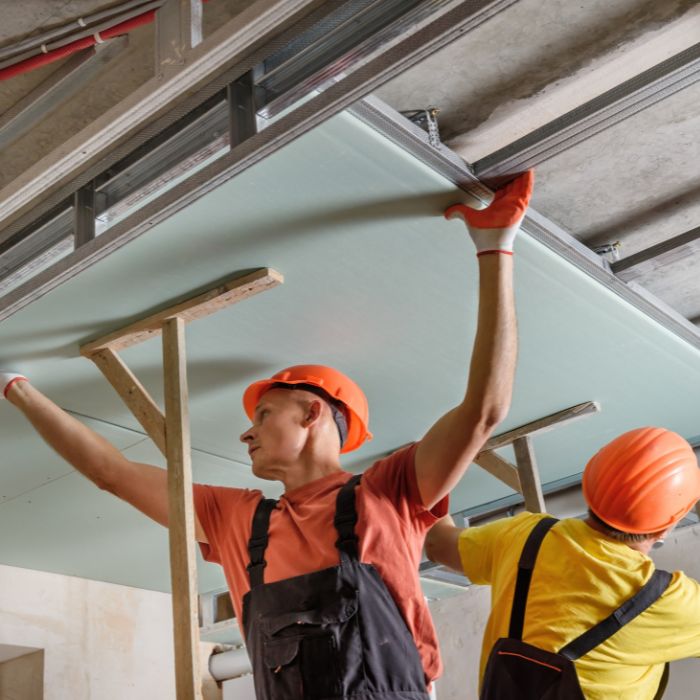
In the intricate ecosystem of modern building safety, there exists a fundamental distinction between ‘Active’ and ‘Passive’ protection. Active systems—sprinklers, smoke alarms, and automated vents—are dynamic; they require power, water pressure, and mechanical sensors to function. If any of these fail, the system fails. In contrast, Passive Fire Protection (PFP) is static. It is built into the very bones of the structure, designed to endure and contain without any external trigger. At the heart of this reliability lies the fireproof board.
For architects and structural engineers, the specification of PFP materials is the most critical decision in the design phase. It is not merely about meeting the baseline of local building codes; it is about guaranteeing the structural integrity of the asset and the survival of its occupants during a catastrophic event. A fire in a high-rise building can reach temperatures of 1000°C within minutes. Standard construction materials like gypsum or plywood will dehydrate, crack, and disintegrate under this thermal shock, allowing the fire to spread vertically and horizontally.
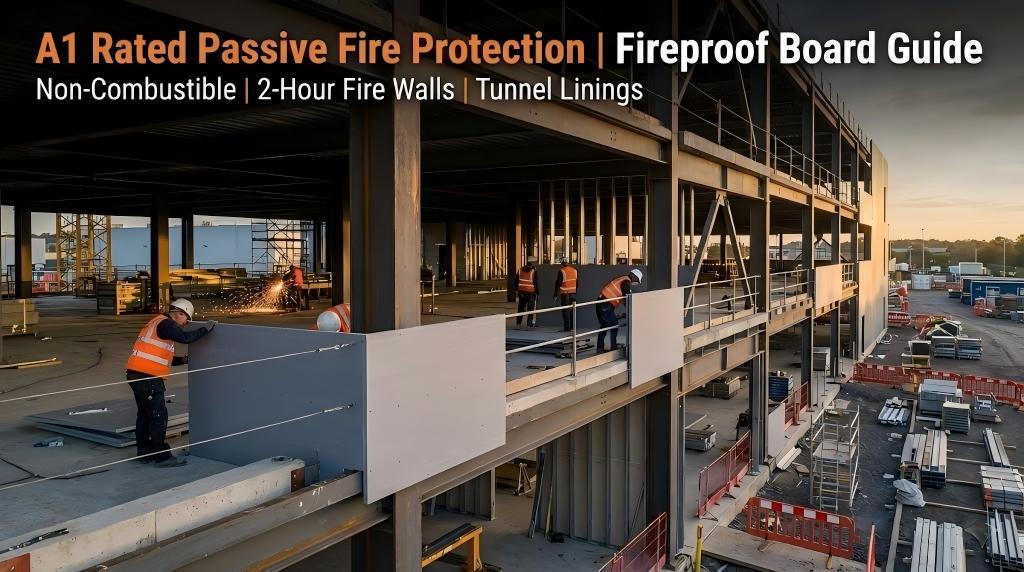
This comprehensive guide delves into the material science of TSM’s A1-rated fire barrier board. We will explore the rigorous testing standards of EN 13501-1, dissect the anatomy of a 2-hour fire-rated wall partition, and analyze why high-density fiber cement is replacing traditional materials in high-risk zones like tunnels and elevator shafts.
The Standards Landscape: Decoding EN 13501-1
Navigating fire codes can be confusing. Terms like ‘fire retardant,’ ‘fire resistant,’ and ‘non-combustible’ are often used interchangeably in marketing, but in engineering, they mean vastly different things. The European Standard EN 13501-1 provides the clearest classification, ranking materials from A1 to F.
Class A1: Non-Combustible (The Gold Standard)
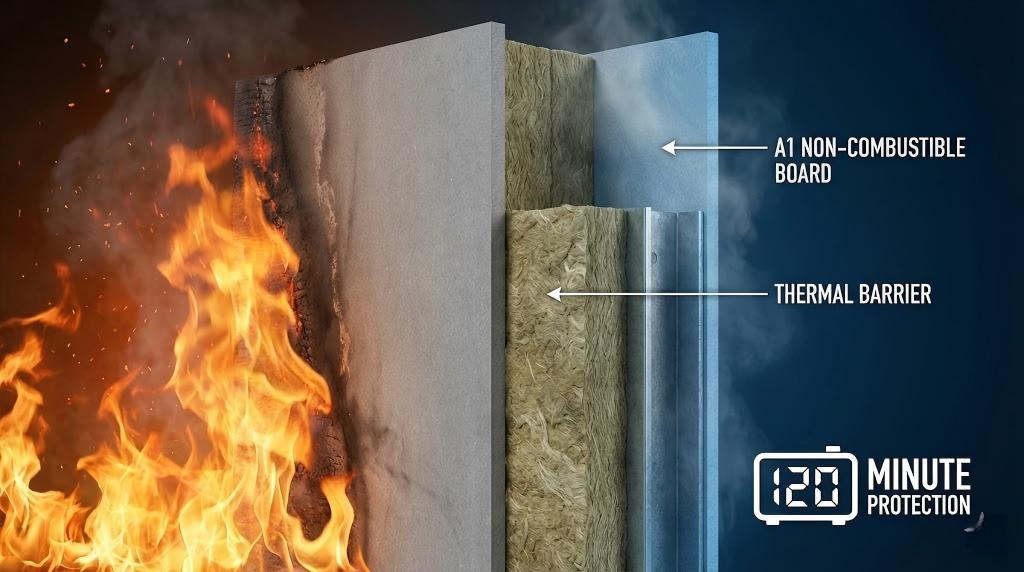
TSM Fiber Cement Board achieves the Class A1 rating. This is the highest possible classification. It means that the material contributes zero fuel to the fire. Even when subjected to a fully developed fire, it will not ignite, it will not sustain a flame, and crucially, it will not produce smoke. This distinction is vital because smoke inhalation is the leading cause of death in building fires, not the heat itself. By using A1 fire resistant building materials, you are actively reducing the toxicity of the environment during an evacuation.
Comparison with Class A2 and B
Many composite panels (such as Aluminum Composite Panels or certain treated woods) claim to be ‘fire resistant’ but are rated A2 or B. This means they have ‘limited combustibility.’ Under extreme heat, the binders in these boards can break down, releasing flammable gases or burning droplets. In a facade fire, these droplets can ignite lower floors, causing the fire to spread downwards. TSM A1 boards eliminate this vertical spread risk entirely.
System Engineering: Constructing the 2-Hour Firewall
A common error in construction is assuming that simply screwing a fireproof board to a wall creates a fire barrier. It does not. Fire resistance is a property of the ‘System,’ not just the board. A system includes the framing, the insulation, the board, and the joint sealants.
To achieve a certified 2 hour fire rated board system (FRL 120/120/120), the assembly must be constructed with precision:
1. The Core (Structure): Use steel stud framing with a minimum depth of 75mm. Steel is non-combustible but loses structural strength at high temperatures. The board’s job is to insulate this steel.
2. The Insulation (Thermal Break): The cavity between studs must be filled with high-density rock mineral wool (min 80kg/m³). This prevents heat transfer through convection currents inside the wall.
3. The Shield (Cladding): Install a double layer of 10mm or 12mm TSM Fireproof Board on both sides of the wall. The double-layer technique is critical. It allows for staggered joints, ensuring there is no direct path for smoke or flame to penetrate. If the first layer cracks under thermal stress, the second layer remains intact.
4. The Seal (Integrity): All joints must be sealed with intumescent acoustic sealant, which expands when heated to block gaps.
The Physics of Spalling: Why Concrete Fails
One of the dangers of using standard high-strength concrete in fires is ‘explosive spalling.’ When moisture trapped inside concrete turns to steam, the internal pressure exceeds the tensile strength of the material, causing it to explode outward. This exposes the steel reinforcement to the fire.
TSM fire rated wall board is engineered with a matrix of cellulose fibers and quartz sand. The fibers create a microscopic pore structure that allows small amounts of internal steam to escape gradually, relieving pressure. This ‘breathability’ prevents explosive failure, ensuring the board remains in place to protect the substrate even after hours of exposure to intense heat.
Critical Applications: Tunnels and Shafts
Tunnels, elevator shafts, and stairwells present a unique danger: the Chimney Effect. In a fire, hot air rises rapidly through these vertical shafts, creating a powerful draft that sucks fresh oxygen into the fire and drives smoke upwards at high velocity.
In these environments, a fire board must withstand not just heat, but also turbulent air pressure (positive and negative). A standard gypsum fire board might survive the heat but could shatter under the pressure waves caused by the draft or by emergency ventilation fans.
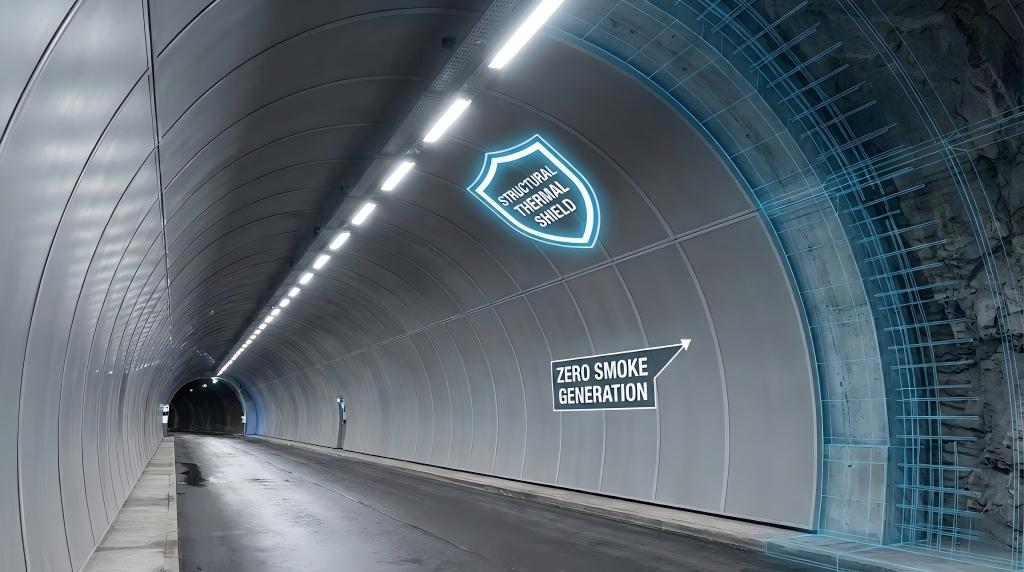
TSM High-Density Fire Board (density > 1.4g/cm³) has the flexural strength to resist these physical forces. It serves as a robust tunnel lining or shaft liner that protects the concrete structure behind it from heat spalling while maintaining the integrity of the evacuation route.
Technical Specification Matrix
| Target Rating (FRL) | TSM Board Configuration | Typical Application |
| 30 Minutes (-/30/30) | 1 layer x 9mm (One side) | Office Partitions |
| 60 Minutes (-/60/60) | 1 layer x 12mm (Both sides) | Corridor / Tenancy Walls |
| 120 Minutes (-/120/120) | 2 layers x 9mm (Both sides) | Server Rooms / Plant Rooms |
| 240 Minutes (-/240/240) | 2 layers x 12mm + Steel Core | Blast Walls / Industrial Storage |
FAQ: Fire Safety Engineering
Q: What is the difference between ‘Integrity’ and ‘Insulation’ in fire ratings?
A: These are the two pillars of PFP. ‘Integrity’ (E) refers to the board’s ability to stop flames and smoke from physically passing through cracks or holes. ‘Insulation’ (I) refers to the ability to stop heat transfer, ensuring that the cold side of the wall does not get hot enough to ignite materials leaning against it. TSM systems provide both.
Q: Can I paint fireproof boards?
A: Yes, but the paint must not compromise the fire rating. You must specify ‘Low Flame Spread’ or non-combustible mineral paints. Avoid heavy oil-based glosses which can act as a fuel source.
Q: Does it release toxic gas?
A: No. TSM boards are 100% free of asbestos, formaldehyde, and toxic resins. In a fire, they release only water vapor. This is critical for life safety. Check our Fire Test Reports for detailed toxicity analysis.
Conclusion: The Moral Imperative
Passive fire protection is not an area for value engineering. The cost difference between a compliant A1 board and a non-compliant substitute is negligible compared to the cost of a life or a total structural loss.
By specifying TSM, you are building resilience into the fabric of your project. You are buying time, safety, and peace of mind. Review our full A1 Board Specifications to ensure your next project meets the highest global safety standards.